
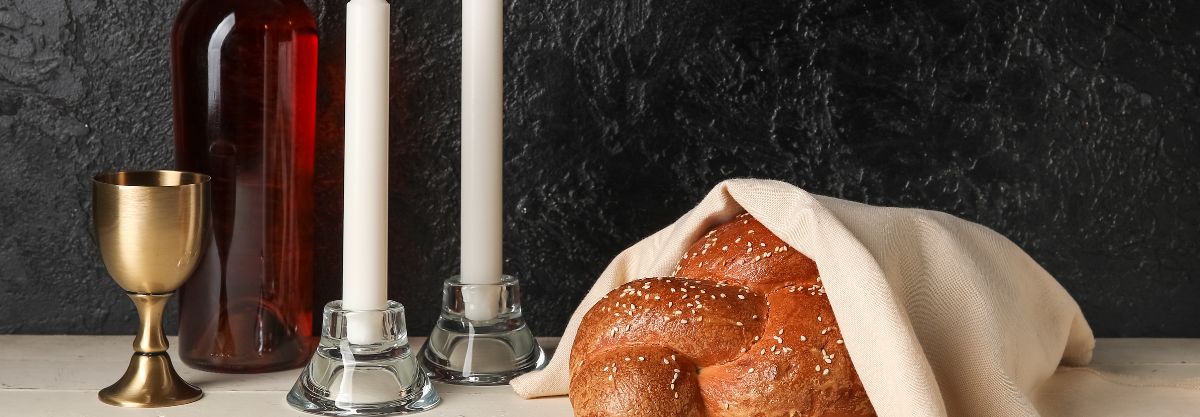
Misconception: Challah means special, braided bread for Shabbat and yom tov meals.
Fact: Because the word challah has two meanings, the two are often confused. In the original rabbinic usage, the term challah most commonly refers to the sanctified portion separated from dough and given to a kohen to be eaten in purity by him and his household. Today, because everyone is assumed to be ritually impure, that separated piece is disposed of respectfully, usually by burning it.1 The more recent usage of the word challah, prevalent in many Ashkenazic communities, refers to bread, usually braided, baked specially in honor of Shabbat. Thus, the original meaning of challah is a holy piece of dough that is forbidden for general consumption, while the more modern usage is bread specially prepared to be eaten by everyone on the holy Shabbat. Both meanings are still used.
Background: English has a variety of terms for specific types of bread, such as baguette, bagel, roll, muffin and hot dog bun. Hebrew likewise distinguishes among different forms of bread with words such as pita, lachmaniyah, challah and laffa, as well as the generic term lechem.2 Although today lechem, like pat, refers specifically to bread, in the Torah it can also denote food more generally (e.g., Bereishit 31:54; 43:25; Mishlei 6:8).
In contemporary usage, the term challah commonly refers to the braided loaves traditionally baked for Shabbat. Historically, however, the word carried a very different meaning. Long before it became associated with Shabbat bread, challah (pl. challot) appeared frequently in Biblical and rabbinic literature. In Biblical Hebrew, the term likely denoted a small, round loaf of bread, often in a priestly or sacrificial context.
Challah in Tanach
The most well-known use of the word challah in the Torah is the priestly gift given as part of the first mitzvah that Jews were to observe upon entering the Land of Israel. Unlike most of the other Land-dependent mitzvot that began to be observed only after the fourteen years of conquest and settlement, the beloved mitzvah to separate challah was applicable as soon as the Jews crossed the Jordan River, as it says (Bamidbar 15:18–20): “When you enter the Land . . . and when you eat of the ‘bread of the land’ (lechem) you shall separate an elevated gift (terumah) for G-d. You must separate the first portion of your kneading as a dough offering (challah) . . . .” In this context, challah refers to the piece given to the kohen. In rabbinic literature, the term came to denote not merely the designated portion itself, but the mitzvah of its separation. Chazal further broadened the scope of this obligation, extending its application beyond the boundaries of the Land of Israel, albeit with certain halachic modifications and leniencies.
The word challah appears in other Biblical contexts, usually Temple-related, and often referring to a specific type of bread. At the inauguration of the kohanim in the desert, three varieties of unleavened bread were brought: 1. lechem matzot, 2. challot matzot mixed with olive oil, and 3. rekikei matzot anointed with olive oil (Shemot 29:2; cf. Vayikra 8:26). Likewise, upon completing a period of nezirut, a nazir was required to bring, among other offerings, challot kneaded with olive oil together with rekikei matzot spread with oil (Bamidbar 6:15, 19). The Mishnah (Menachot 3:6) refers to the two loaves offered on Shavuot simply as “shtei challot—two challot.”
“Challah” is also used to describe a type of “baked minchah” that consists of “unleavened loaves (challot) made of wheat mixed with olive oil” (Vayikra 2:4). Ibn Ezra (Shemot 29:2; Vayikra 2:4) suggests that the word challot in that context means either thick or round3 (loaves) because its root is the same as that of chalilah (cf. Sukkah 55b), which means to go round and round. Likewise, when the women celebrated with Miriam after the splitting of the Red Sea, they are described as following her with drums and mecholot (Shemot 15:20), understood to refer either to (circular) dancing4 or to a round instrument. Similarly, a chalil is a round hollow reed or flute.
Rabbi Yaakov Tzvi Mecklenburg (HaKetav VehaKabbalah, Vayikra 8:26) says that the Aramaic translation of challah, kritzta, is, according to Mossaf HaAruch, derived from the Greek word for round,5 and that challah received its name because of its round shape. Similarly, he says, vesa’ar mitcholel (Yirmiyahu 23:19) refers to a whirling, circular storm, a cyclone. He further suggests that other words for bread, such as ugah6 and kikar, also stem from roots meaning round.
After King David joyously brought the Ark to Jerusalem (Shmuel II 6:19), he distributed food, including a challat lechem, to all the people. How does the word challah modify lechem in this phrase? According to Metzudat Tzion, a complete loaf is called a challah. Radak notes that the parallel account in Divrei Hayamim I (16:3) uses the term kikar instead of challah. He explains that the loaves distributed by David were the size of a kikar but had the form of a challah.
Challah is not only used to describe baked bread. The Mishnah (Uktzin 3:5) mentions challot chari’a, saffron loaves [they would preserve the raw spice, saffron, in loaves or piles, in ancient times] and (Shabbat 22:1; Uktzin 3:11) challot devash, honey “loaves,” i.e., honeycombs, likely because of their round shape. In the case of honeycombs, the term may refer to the shape of the individual wax cells.
Challah as Shabbat Bread
Every Friday in the Beit Hamikdash, the twelve showbreads were baked, and the next day were placed on the Shulchan [golden table] in the Kodesh. The following Shabbat, miraculously still fresh, they were eaten by the kohanim. Known as lechem hapanim (Shemot 25:30), they were called challot (Vayikra 24:5). In this context, challah refers to “Shabbat bread” of the kohanim.
Calling Shabbat bread “challah” is at least several hundred years old. The Mishnah advises (Shabbat 2:7 [34a]): “A person must say three things in his home on Friday afternoon close to nightfall: Have you tithed [the produce]?; placed the eruv?; [now] light the Shabbat candles!” Following Maharam MiRotenburg, the Shulchan Aruch (OC 260:2), compiled in Tzefat in the sixteenth century, replaced the question about tithing, which was not very common in their milieu, with “Have you separated challah?” The Eshel Avraham (Buchacher, OC 260; see Mishnah Berurah 260:13) says that he has never seen or heard of anyone asking the challah question. He suggests that that’s7 because in his generation people referred to the bread baked in honor of Shabbat Kodesh as challah. The very name of the bread, he writes, served as a reminder to perform the mitzvah of separating challah, eliminating the possibility of forgetting. Saying “let’s bake challah,” or using similar phrases, was a good reminder to separate challah. He further suggests that rabbis who advocate asking if challah was taken are likely from places where the Shabbat bread is not called challah. The Eshel Avraham was written by Rabbi Avraham David Wahrman of Buchach (1770–1840) in Galicia (western Ukraine), which was part of the Austrian Empire at the time. This suggests that, 200 years ago, Shabbat bread was called challah in Galicia but not necessarily in other regions.
It has been suggested that the fifteenth-century Leket Yosher is the earliest source to use the term challah to refer to Shabbat bread (Hilchot Erev Shabbat 12): “I remember that on every Friday afternoon, they would make three thin challot made by kneading with eggs, oil, and a little bit of water…” However, it seems that this was merely a descriptive reference and not yet a unique name for Shabbat bread, because later in that section (25) it also refers to Shabbat bread simply as lechem or kikar and to thin challah
on weekdays.
Among English-speaking Jews, challah is today the most popular name for Shabbat bread, but it is not universal. The best-known modern exception is among South African Jews, who still use the term apparently once favored by Lithuanian Jews, kitka, which likely derives from a Slavic word for a braided ponytail and was adapted to describe the braided loaves used on Shabbat. Across prewar Europe, Shabbat bread was known by a variety of names. In addition to the popular “challah,” which was nearly universal in Eastern Yiddish, and berches,8 which was popular in Western Yiddish, and kitka, several other terms were used, including dacher, koylasch9 and shtritzl.10
The Rema (OC 242:1) records, seemingly based on Bava Kama 82a,11 that there is a long-standing custom to bake Shabbat bread on Friday, and that this is done for kavod Shabbat. Furthermore, he suggests kneading enough dough to require separating challah, thus enabling one to fulfill the mitzvah of taking challah (MB 242:6; Shach, YD 324:25), a mitzvah primarily incumbent on women (Mishnah, Shabbat 2:6).12 Indeed, the mitzvah of taking challah has great merit and is listed as one of the three special commandments for women. Taking challah on Friday is viewed as a rectification of Chava’s primordial sin on the first Friday, which brought ruin upon the world and upon Adam, the “challah of the world”13 (see Y. Shabbat 2:6). However, the modern phenomenon of challah-baking events or groups gathering to separate challah for someone’s merit is a late twentieth-century development. In recent years, these efforts have often been dedicated to IDF soldiers.
The Biur Halachah (s.v. vehu; published in 1891 by the Chafetz Chaim) bemoans that in his day, some women had abandoned the practice of baking challah on Friday and instead bought bread from bakeries. Ohr LeTzion (2:47:1; published 5753/1992 by Rabbi Ben Tzion Abba Shaul in Israel) says there is nothing to condemn. The complaint of the Biur Halachah applied in his day when the choice was buying regular (non-Shabbat) bread from the bakery or having special Shabbat bread baked at home. But today, when bakeries sell special Shabbat bread—challah—buying it from a bakery does not diminish kavod Shabbat.14
There are two main reasons offered for the custom of baking Shabbat bread at home: kavod Shabbat and separating challah.15 An example of where these two reasons diverge is a woman who has a small family and must choose either to bake fresh challah every week in quantities less than the shiur for separating challah (to fulfill kavod Shabbat by serving fresh challah) or to bake a large batch every few weeks and freeze the challah for use each week (thereby fulfilling the mitzvah of challah). Rabbi Shimon Baruch (Likrat Shabbat, 5761, pp. 47–48, chap. 4, n. 20) quotes opinions in both directions, though he notes (n. 1) that from a simple reading of the Rema, it seems that of the two reasons, the primary purpose of this custom is to fulfill kavod Shabbat.
There are various explanations for why in many places Shabbat bread became known as challah. The Jewish Encyclopedia suggests16 that because the housewife would conscientiously separate challah specifically on Friday when making the fresh Shabbat bread, the bread itself came to be called challah. Others suggest that the name served as a reminder to separate challah. Alternatively, it is possible that the name challah is related to other Biblical usages of the word: a round loaf, a whole loaf, or the original “Shabbat bread” of the kohanim—lechem hapanim—which were called challot matzot.
Calling the Shabbat bread “challah” may have deeper significance relating to the transition from the supernatural manna to the natural world and our ability to sanctify the natural. Chazal (Shabbat 117b) decreed that the Shabbat meals include two loaves of bread in commemoration of the double portion of manna received on Friday (Shemot 16:22).17 Rashi (Bereishit 2:3) says that this double portion of manna was the blessing G-d gave to Shabbat. The Tur (OC 271) and Tosafot (Pesachim 100b; s.v. she’ein; see Aruch HaShulchan, OC 271:22) explain that one of the reasons the bread is covered on top and bottom is because the manna was enclosed both top and bottom by dew (Yoma 75b, reconciling the seemingly contradictory verses of Shemot 16:14 and Bamidbar 11:9). When we look at the two Shabbat breads resting between the challah tray and a cover, we are reminded of the miraculous manna that fell in the desert.
Why did Chazal institute that the manna, which ceased falling just before the Jews entered the Land of Israel with Yehoshua, be commemorated every Shabbat? It may be that there was a “handover” to the mitzvah of challah when the manna stopped. The mitzvah of separating challah took effect as soon as the Jews crossed the Jordan River into the Land of Israel. In the desert, each day of the week, each person received one omer of manna (Shemot 16:16), which is a tenth of an ephah (Shemot 16:36). Precisely when the manna stopped falling, the Jews became obligated to separate challah from an omer of dough [estimated at between two and a half and five pounds of flour], the exact measure of manna each person received daily in the desert.18 What is the significance of relating the manna to challah? The mission, the destiny, of the Jewish nation is not to live a miraculous existence on manna in the desert, but to live as a holy nation in the physical world of the Land of Israel.
This links the earthly bread, lechem min ha’aretz, of the Land of Israel, with the heavenly bread, lechem min hashamayim (Shemot 16:4), that sustained the Jewish people in the desert. On Shabbat, the two loaves of bread represent the double portion of manna and demonstrate that physical bread on Shabbat can be elevated to the level of the spiritual bread of the desert by performing mitzvot, i.e., hafrashat challah. By calling the Shabbat bread “challah,” we highlight the link between the manna and the mitzvah of separating challah.
Notes
1. Because of this, the quantity separated today is much smaller. Previously, a private individual gave of the dough and a commercial baker (Mishnah, Challah 2:7). Today a kezayit (Rema, YD 322:5) or less (Shemirat Shabbat Kehilchatah 42:12, n. 48) is taken.
2. The Arabic cognate, laḥm, means meat.
3. Jastrow translates challah as “[rolled, rounded] cake,” with cake referring to a baked flour-based food, not the modern connotation of sugar-laden dessert. The Even-Shoshan Dictionary also suggests, based on the root of chalal, the meaning round or hollow, but also includes the possibility that it relates to chilah, meaning to sweeten (as in Shemot Rabbah 43) and thus would be sweeter bread. BDB (Brown–Driver–Briggs Hebrew and English Lexicon) says it is ring-shaped bread, and HALOT (Hebrew and Aramaic Lexicon of the Old Testament) says it may be perforated loaves.
4. See also Y. Megillah 2:4, where cholah is a dance circle.
5. I have been unable to find a similar-sounding Greek word that means round.
6. As part of the great machine-matzah controversy, it was argued (Mahari Assad, Shu”t Yehudah Ya’aleh, 157) that matzah should be round, as that is the meaning of ugot in ugot matzot (Shemot 12:39). On that controversy, see Ari Greenspan and Ari Zivotofsky, “Hand or Machine: Two Roads to Fulfilling the Mitzva of Matza,” Jewish Observer 37, no. 4 (April 2004).
7. Pitchei Teshuvah, YD 323, s.v. bechu”l, quotes Knesset Yechezkel 23 that in the year 5487 [1727] when erev Pesach was Shabbat, he explained that the reason people nowadays usually don’t ask about challah is because outside of the Land of Israel, where separating challah is a rabbinic obligation, if one forgot to do so, there is a workaround even on Shabbat—a workaround not applicable when erev Pesach is Shabbat (quoted approvingly in Derushei HaTzlach 36:15 [pp. 243–44, 5762 ed.]). Minchat Yitzchak (6:46: intro) says that if that is the reason (and not as the Eshel Avraham says), then in the Land of Israel, where the mitzvah was originally Biblical and the workaround is not applicable, one should ask “Have you separated challah?” every Friday afternoon. Rabbi Shlomo Zalman Auerbach (Halichot Shlomo, Moadim: Pesach, 9:Orchot Halachah 1) suggests the reason it is not asked even in Israel is because the time to separate challah is during the dough stage, and immediately before candle lighting the dough is already baked, and the working assumption is that challah was taken at the proper time. This, he notes, would not apply to erev Pesach because with matzah, challah is taken not from the dough, but from the baked matzah.
8. Variously spelled barches, barhes or berches, with varying suggested reasons for that name. Some suggest it relates to a berachah being said over it, either when challah was separated or at the Shabbat table. Others say it was simply adopted from a similar-sounding German word for braided bread. Some pronounced it birshut because before reciting the berachah for others, the person first asked permission by saying birshut.
Over 150 years ago, the following explanation was given: “The well-known Sabbath bread, called ‘Berches’ in Northern Germany and Poland, from berachah, because the Sabbath blessing is spoken over it . . . According to some, both names, the more Southern German “datscher” as well as the Northern German ‘berches,’ are based on the words of Proverbs 10:22: ‘Birkat Hashem hi ta’ashir—The blessing of the Lord makes rich.’ . . . To us, it seems to be related to the French tarte, English tart, Medieval Latin and Italian torta, meaning twisted, wound, braided, and thus describes the shape itself, as the word may have originally been called Tartche” (Abraham Tendlau, Sprichwörter und Redensarten Deutsch-Jüdischer Vorzeit [Proverbs and Idioms of the German-Jewish Past], 1860, p. 347, footnote; https://www.digitale-sammlungen.de/en/view/bsb10570871?page=362,363).
9. The name koylasch was used by Rashi (commentary to Pesachim 48b, s.v. aval) to describe a kind of long, thin bread.
10. For details on the distribution of these various terms, see the linguistic maps in Language and Culture Atlas of Ashkenazic Jewry, vol. 3, pp. 29–30 and 350–61 (maps).
11. Based on Darchei Moshe, OC 603:1 it seems that the Rema had a slightly different text than is standardly found in Bava Kama. The standard text says that Ezra made ten takanot; one was that women should arise early and bake bread, with no mention specifically of Friday, and that was how Rashi had it as well. The Rema seems to have had a version that said it was specifically on Friday.
12. Based on the story of the wife of Rabbi Chanina ben Dosa (Ta’anit 24b–25a), it seems that the custom of baking challah on Friday in honor of Shabbat already existed in Talmudic times. However, that story does not provide evidence that they baked enough dough to fulfill the mitzvah of challah.
13. The reference to Adam as “challah” (see Bereishit Rabbah 14:1, 17:8 and many other places)—including in the context of baking challah on Friday (Magen Avraham 242:4)—is borrowed terminology and does not shed light on the meaning of the word challah. It is simply a metaphor: Just as challah is separated from the completed dough and becomes holy, so too Adam, created last, represents the culminating and sanctified element of Creation. Machatzit Hashekel (OC 242:4) offers a similar idea: just as the dough is completed by taking challah, so too the world was completed by the creation of Adam. Alternatively, Pnei Moshe (Y. Shabbat 2:6) suggests that G-d mixed soil and water and took the best part to make Adam, paralleling the making of dough and the taking of a portion as challah.
14. For an elaboration and other opinions, see the lengthy note 4 in Likrat Shabbat, chap. 4.
15. Some people offer a third reason: to make sure the bread is pat Yisrael, a worthy chumrah to have on Shabbat (Aruch HaShulchan, OC 242:45).
16. Jewish Encyclopedia, 1906, entry “Barches,” (written by Cyrus Adler and Kaufmann Kohler) https://jewishencyclopedia.com/articles/2514-barches.
17. The obligation of three Shabbat meals is also linked to a pasuk about the manna (Shabbat 117b, based on Shemot 16:25). This miracle affected all Jews, which is why men and women are obligated in eating seudah shelishit. See Ari Z. Zivotofsky, “What’s the Truth about . . . Seudah Shelishit?” Jewish Action 72, no. 2 (winter 2011).
18. The textual basis for this is the pasuk that discusses the mitzvah of taking challah (Bamidbar 15:20), where the text refers to “reishit arisoteichem—the first of your dough.” Rashi asks: What does the phrase “your dough” mean? Does it mean that any size dough requires you to separate challah? He explains that “your dough” refers to a very specific measure, the quantity of manna each person received, an “omer per head” each day. The Mishnah states that the minimum amount required for challah equals of a kav (Mishnah, Challah 2:6; cf. Ediyot 1:2), and Rav MiBartenura demonstrates how that is derived directly from the measure of
an omer.
Rabbi Dr. Ari Z. Zivotofsky is a professor of neuroscience at Bar-Ilan University in Israel.