
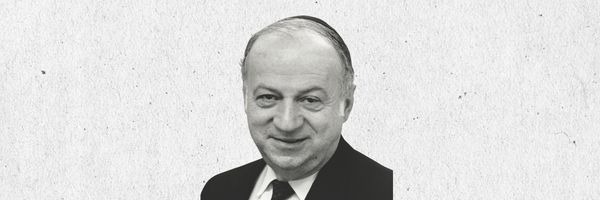
Rabbi Julius “Julie” Berman,a”h (1935–2025)
Courtesy of Yeshiva University Archives
The world of American Jewry is often defined by its institutions, but those institutions are defined by the giants who lead them. With the passing of Rabbi Julius “Julie” Berman, we have lost not only a titan of leadership but also a pioneer of a distinctive and dignified synthesis: an unapologetic Orthodox Jew who commanded the respect of the entire Jewish world.
Julie was a man of firsts. Notably, he was one of the first Orthodox Jews to serve as chairman of the Conference of Presidents of Major American Jewish Organizations. In an era when the Orthodox community was often viewed as insular or peripheral to the broader American Jewish agenda, Julie stepped into the breach. His profound legal mind and unshakable integrity made him the natural choice to represent the collective interests of our people.
Intellect and Integrity
Julie’s intellectual pedigree was unmatched. He graduated first in his class at New York University Law School, and that sharp, analytical mind informed every communal role he occupied. Nowhere was this more evident than in his work with the Orthodox Union.
Julie served as OU president from 1978 to 1984, where he launched a number of important initiatives, including Yachad, a pioneering program to enhance the lives of Jews with developmental disabilities. As chairman of the OU Kashrus Commission, Julie presided over the Joint Kashrus Commission—a body composed of OU lay leaders and rabbis from the Rabbinical Council of America (RCA). These meetings could often be contentious, dealing with complex halachic and logistical issues. Yet, in every room Julie entered, his word was dispositive. It wasn’t because he sought power, but because everyone—from the most seasoned poskim to the most pragmatic laymen—held him in such high regard.
The Rav’s Trusted Counsel
Perhaps the most telling testament to Julie’s character was his relationship with his rebbi, Rabbi Joseph B. Soloveitchik, the Rav. It is well known that the Rav held Julie in the highest esteem. In fact, the Rav once remarked to me personally that he believed Julie should have been president of Yeshiva University. In a fitting closing of the circle, Julie’s nephew, Rabbi Dr. Ari Berman, today holds that very office.

Courtesy of Yeshiva University
Julie served as the Rav’s legal counsel for many years, handling all of his personal and professional legal matters. The Rav, ever sensitive to the time and effort of others, insisted on paying for these services. Julie, out of a profound sense of kavod harav, steadfastly refused. In a gesture of deep appreciation for his loyalty and friendship, the Rav gifted Julie a portrait of himself—a rare, deeply personal token of their bond.
He moved in the highest circles of power . . . yet he remained a humble servant of the Jewish people and a loyal student of his rebbi.
Their relationship was also marked by a shared sense of humor and a mutual understanding of the world’s absurdities. I recall a story from the aftermath of the Sabra and Shatila massacre. A newspaper claimed that the Rav had called Prime Minister of Israel Menachem Begin on Yom Kippur to urge him to appoint an investigative commission. The Rav, rightfully indignant at such a ridiculous libel, wanted to sue the paper. Julie, with his characteristic wit, told him: “Rebbi, in order to sue for libel, the claim has to be credible. No one in the world would believe that Menachem Begin would pick up the phone on Yom Kippur!” The Rav couldn’t help but concede the point.
A Legacy in Print
Julie’s commitment to the Rav extended far beyond legal advice; he was the primary engine behind the preservation of the Rav’s intellectual legacy. As chairman of both OU Press and the Toras HoRav Foundation, Julie spearheaded the publication of the Rav’s sefarim.
He was particularly enthusiastic about publishing the Rav’s derashot in their original Yiddish. OU Press published an English translation of the Rav’s derashot delivered at the Mizrachi conventions, but in addition to the English translation, Julie insisted that we also publish the derashot in their original Yiddish, which we did in a separate volume. (Both volumes were sponsored by Julie, and their covers bear the Rav’s portrait—the one the Rav had given him as a gift.) I remember the Rav’s daughter, Dr. Tovah Lichtenstein, asking why we were putting so much effort into publishing the Rav’s Mizrachi derashot in Yiddish. I answered her quite simply: “For Satmar.” The real answer was that Julie was adamant about preserving the Rav’s majestic Yiddish oratory in its original form, even if there were few left to appreciate it.
The Har Etzion Connection
Julie’s heart was also deeply rooted in the halls of Yeshivat Har Etzion. He shared a lifelong friendship with Rabbi Aharon Lichtenstein, zt”l, dating back to their days as classmates at YU. Whenever Rav Aharon would visit America, the Berman home was his home; he stayed with Julie and his wonderful wife, Dorothy.
The Bermans’ role went well beyond hospitality; they were partners in the yeshivah’s mission. Dorothy continues to serve as president of the American Friends of Yeshivat Har Etzion, a role she has filled with distinction. This connection was emblematic of Julie’s worldview: a bridge between the American Torah center and the flourishing world of the Israeli hesder yeshivot.
Rabbi Berman was a man of the law, but he was governed by Torat Emet. He moved in the highest circles of power—meeting with presidents and prime ministers—yet he remained a humble servant of the Jewish people and a loyal student of his rebbi. He taught us how an Orthodox Jew can lead with excellence, serve with humility and leave a legacy that will speak for generations to come.
May his memory be a blessing.
Rabbi Menachem Genack is CEO and rabbinic administrator of OU Kosher.
In This Section
The Dispositive Word: A Tribute to Rabbi Julius Berman by Rabbi Menachem Genack
A Friend, a Scholar, a Life Remembered by Joel M. Schreiber