
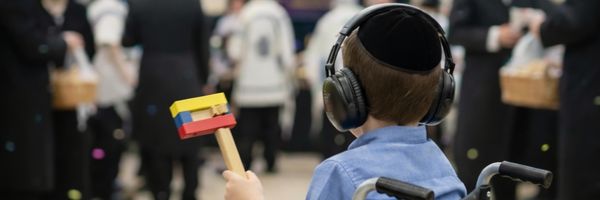
Jewish Action’s associate digital editor, Rachelly Eisenberger, had a chance to sit down with Yachad’s managing director of regions, Rebecca Mayer, to discuss how we can help children with disabilities enjoy Purim.
Rachelly Eisenberger: Why is it so important to think about accessibility on Purim?
Rebecca Mayer: When it comes to holidays in the Jewish community, you need to think about the entirety of the community. This is an opportunity to create a comfortable space for everyone. It’s everyone’s holiday, not just for people who can tolerate the loud noises and drive around from house to house.
It is a very meaningful, fun day. With small tweaks and adjustments that allow for more entry points, the holiday becomes much more accessible. For example, if a Megillah reading in a certain shul or community is known to be very loud and rowdy, that may stop somebody from even entering the building. But from the onset, if there’s advertisement that there is a quieter Megillah reading with less booing for Haman or less sensory overload, that may get somebody to join who wouldn’t have ever seen that point of access.
Planning goes a long way in helping people feel comfortable.
RE: You mentioned one way to keep Megillah readings manageable. What are some other ways communities can make Megillah readings more sensory-friendly without taking away from the mitzvah?
RM: There are various things we can do.
It’s festive when there’s a horn blowing and people throwing fire poppers, sure. That’s fun for certain people, but there are also people covering their ears. There are better ways to erase Haman’s name, such as hand gestures, holding up a sign, or instead of a loud horn, having a shaker with pom-poms or something softer that isn’t as jarring.
There are many minyanim that have you boo at the start and the end but not during the majority of the Megillah, which can be a little bit easier for somebody who gets overwhelmed by too many loud noises.
Then there are tweaks like offering a bin of noise-canceling headphones or earplugs, which sends a message of “come on in, we want you here. You’re going to be a part of the Megillah just like everyone else, it just won’t be as loud for you.”
A number of years ago, Yachad put out a DVD for shuls to play during the Megillah with captions, where the word would light up in red as it was read. Because this holiday allows technology, we can do a lot: microphones, displays, large print. It creates more points of access for people with hearing or visual impairments, language barriers, or concentration challenges.
And I would say people also need to know what to expect. I really like when minyanim hold up signs letting you know that it’s time to boo. The more that we’re prepping people and they know what to expect, the less they’ll be surprised and overwhelmed.
RE: Why is predictability so important for many individuals with disabilities, especially on a holiday like Purim? And how can parents, schools or shuls help people know what to expect throughout the day?
RM: Knowing what to expect helps people feel more at ease. In general, especially for individuals with developmental disablities, we want to eliminate surprises and get them as comfortable as possible.
People generally are not reading the Megillah in the places where they spend most of their time, like their house or bedroom. It’s a different location, and that could be uncomfortable for some. But getting some additional familiarity with the location allows for ease. This could mean coming a little bit early and seeing the space ahead of time, knowing where the quiet areas are, where the bathrooms are, and how many people fit into the space. When a person comes in with knowledge of what to expect, they feel more a part of it instead of wondering what’s happening next. Otherwise, surprise can turn into anxiety.
Reviewing a schedule of the day also helps with predictability. This could mean making a schedule as a family: This is the time we’re going to hear the Megillah. This is when we’re delivering mishloach manot; we’ll all be in the car together and taking turns delivering to different friends. Then our seudah is at this time; these are the people coming. The kids will be sitting in this room, the adults in that room.
Or, it could be in the form of a social story, rehearsing and giving space for questions.
Here, a person is becoming part of the planning. They have control over it. They know when to be flexible and when they have your own time.
RE: Purim often involves moving quickly from one activity to the next. Why is it so important to intentionally build in quiet time?
RM: Knowing that you are going to have time and space to recharge fuels the ability to jump from Purim activity to Purim activity. Even if the break isn’t long, you know it’s coming.
With regard to the busyness of the day, make sure people are drinking water and eating something beyond candy from mishloach manot. You want to avoid crashes. And you don’t want people being “on” for so many hours straight. It’s a tall order. Without planned breaks, the body creates one. You see people disengage, pull back, and show more challenging behaviors because they need regulation.
For shuls and schools planning carnivals or Purim activities, having something small on a flyer saying that for this half-hour window it’s going to be low sensory—loud machines off, music lowered—creates more access.
There are many great activities that aren’t as sensory stimulating as face painting or bounce houses. Arts and crafts tables or making dough into hamantaschen are lower sensory and may be more comfortable for a wider group.
And having the option of a quiet zone is good. It’s important for people to have a choice, to feel they have some control over the overwhelm around them. And sometimes, somebody just being in the same building as everyone else is a win, even if they don’t look like they’re following the rest of their family. But the fact that they’re there and engaging and having a positive experience in the quiet zone, that’s a big deal.
RE: The mitzvot of Purim are deeply interpersonal. How do mishloach manot and the Purim seudah create opportunities for meaningful inclusion?
RM: Purim is a very social time. I want to be clear: Just because somebody has a disability does not imply that they don’t have a social life. But practically, it may be harder for them to socialize, or they may not be in the same school or environment as neighbors their age.
Inclusion is so much more than having physically accessible space, like a ramp into shul or braille/large-print options. Inclusion is an attitude.
When you’re packing your dozens of mishloach manot, think about who isn’t looking at it as another bag of sugar to hide from their kids, but who may really appreciate that delivery. Instead of addressing it generally to “the Cohens,” you can say, “This is for you, Moshe. I made this,” so the person feels personally seen. It’s such a small thing. The ability to reach out strengthens relationships, especially for people who may have smaller social circles.
It’s also important to keep in mind allergies when you’re preparing your mishloach manot. In terms of wrapping, think about people with sensory sensitivities: Loud, textured cellophane can sometimes be overwhelming, and sticky foods put in the same bag as everything else can be an unpleasant surprise.
It’s the same with the seudah. Think about who may not have a seudah that’s comfortable for them. Invite someone and ask what would make it most comfortable—accessibility into the house, less sensory stimulation, food choices. Asking that question goes very far.
Above all, keep the mindset of including everyone and helping everyone engage.
If the goal of Purim is simchah, there are so many ways to create simchah by having more people in mind.
RE: If parents or community members remember just one thing about accessibility and inclusion this Purim, what would you want it to be?
RM: While we spend so much time planning the seudah menu, perfecting costumes, and coordinating mishloach manot, spend some time planning the day and how it can be most meaningful for every member of the family.
Purim is a fun, loud, social, and at times hectic holiday. With a bit of planning, we can ensure that individuals with disabilities are able to participate meaningfully and comfortably.