
On Shavuos, there is a minhag to eat dairy meals. One well-known explanation is that when the Torah was given at Sinai, the Jewish people were suddenly confronted with many new halachos governing kosher meat. Unprepared to eat fleishigs according to these new standards, they turned to dairy foods until they could learn the laws of shechitah and properly prepare kosher meat.
Now, although I doubt they ate fettuccine Alfredo or cheesecake with dripping chocolate frosting, that’s not the point. The custom is simply to have dairy, as they did, and so we prepare delicious dairy dishes in honor of the yom tov—each generation in its own way.
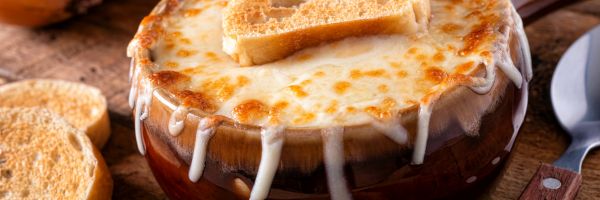
One of the special highlights of Shavuos for my children is their Savta’s French onion soup, made all the more delicious with shredded mozzarella melted in it.
Before I continue, I need to digress for an important distinction. A few years ago, my wife was especially busy, so I decided to make dinner for the family. We were also hosting family friends, and I thought it would be nice to prepare something a little extra special. I planned a delicious dairy meal and, drawing on my experience at my mother-in-law’s table, served French onion soup as the first course (albeit mine was store-bought, and I didn’t have shredded cheese to accompany it).
When the soup was cleared and I proudly brought out the dairy main course I had worked so hard to prepare, one of our guests looked at me and said, “Rabbi, aren’t we all fleishigs? Isn’t French onion soup usually made with meat?” After consulting the ingredients on the container, I confirmed the guest was, unfortunately, correct.
(Before you start thinking about the collateral damage I caused in our kitchen, keep in mind that I didn’t really like that milchig pot or ladle anyway . . .)
From that meal, I walked away with two takeaways: lots of untouched dairy food that we enjoyed for dinner the following night, and the understanding that not all pots of French onion soup are created equal.
Despite the soup I bought in error, the classic homemade, pareve French onion soups, which many of our readers love to serve on Shavuos, are traditionally served with melted cheese on top.
This year, a halachic question concerning French onion soup and other Shavuos delicacies is particularly relevant, as the second day of Shavuos falls on Shabbos. Melting cheese on yom tov is permitted, as cooking is allowed on yom tov. But what about melting cheese on Shabbos?
For some families, this is a halachic question of real consequence. What about the child who refuses to eat anything besides cheesy noodles or grilled cheese? Is there hope for them on Shabbos?
And what if you simply love melted cheese? As one of my cousins likes to say, “Whoever said ‘diamonds are a girl’s best friend’ forgot about melted cheese.”
When considering this question, there are several halachic issues to keep in mind:
• Molid: the rabbinic prohibition (according to Ashkenazim) against changing a solid into a liquid, such as warming congealed gravy until it melts back into liquid form
• Chazarah (nesinah lechatchilah): the rabbinic prohibition against warming food on Shabbos in a way that appears like cooking, or out of concern that one may come to adjust the fire
• Bishul: the Torah prohibition against cooking on Shabbos
Let us address each issue separately.
For some families, this is a halachic question of real consequence. What about the child who refuses to eat anything besides cheesy noodles or grilled cheese? Is there hope for them on Shabbos?
The prohibition of molid does not apply to simply melting cheese onto a piece of bread or even into onion soup. The cheese does not turn into a liquid. Even though it becomes softer and stringy (and more delicious!), that does not qualify it as a liquid. Therefore, molid in such a case is not a concern.
What about the actual method used to warm the cheese so that it melts? The halachos of warming food on Shabbos are vast and nuanced. To keep things simple, we will limit our discussion to two cases that all will agree have no rabbinic prohibition of chazarah (nesinah lechatchilah):
1. Putting cheese into your bowl of pareve soup that is on the table in front of you, not in the pot
2. Kedeirah al gabei kedairah (a pot on top of another pot)—for example, putting noodles and shredded cheese in a 9×13 pan, and then putting the pan to warm on top of a pareve potato kugel that is already sitting on your blech or hot plate
Almost all other convenient ways of making grilled cheese, cheesy noodles and the like will be prohibited because of chazarah (nesinah lechatchilah).
The Torah’s prohibition of cooking on Shabbos, however, requires careful consideration.
It would certainly make things easier if we could assume that all cheeses were already cooked in their cheese state, because once a solid food has been cooked, there is no prohibition against cooking it again (ein bishul achar bishul).
However, after consulting with a cheese expert, it appears that even mozzarella—which is considered a “cooked cheese”—is not always heated to a high enough temperature (approximately 160°F) to qualify as “cooked” according to halachic standards. In addition, new cheese-making technologies and methods are emerging that may not necessitate cooking at such high temperatures. Therefore, when dealing with a potential Torah prohibition, we cannot rely on the principle of ein bishul achar bishul to permit melting cheese.
Interestingly, even though cheeses are not always cooked in their solid form, cheeses commonly found in our homes are often made with pasteurized milk.
While generally on Shabbos one is not permitted to cook a liquid even if it was cooked beforehand, the Tzitz Eliezer (14:32) allows putting pasteurized milk into a cup of hot coffee (which would be a kli sheini [second vessel]) even if the milk will reach yad soledes bo (cooking temperature). While the rationale for his ruling is beyond the scope of this article, what’s important for our discussion is that he permits pasteurized milk in a cup of coffee because it is a kli sheini, similar to a bowl of soup. (See https://oukosher.org/halacha-yomis/may-i-add-milk-to-a-hot-coffee-on-shabbos/?utm_source=chatgpt.com for more details.)
As such, there are three main takeaways:
First, if your husband makes dinner for you, it’s the thought that counts.
Second, according to the Tzitz Eliezer, one would be allowed to melt cheese made from pasteurized milk into a bowl of pareve French onion soup, assuming the relevant conditions of a kli sheini are met.
Third, melting cheese on top of any direct heating element is not recommended unless one knows for sure that the cheese was produced at a temperature above 160°F.
Rabbi Ezra Sarna is OU director of Torah and Halacha Initiatives.