
A Woman Is Responsible for Everything: Jewish Women in Early Modern Europe

By Debra Kaplan and Elisheva Carlebach
Princeton University Press
Princeton, New Jersey, 2025
488 pages
Reviewed by Rebbetzin Dr. Tzipora Weinberg
Over two thousand years ago, a Jewish woman wrote a book. In it, she documented the mundane alongside the miraculous, the particularity of her time, and her own role in effecting the salvation of her people. But she was not satisfied with the authorship of the work alone. Her expression to the Sages was direct, if not plaintive: Immortalize me for generations to come. Lest they be forgotten, record my words as part of the eternal canon.1
Between that time and the present, Jewish women have come and gone, but from the medieval period until modern times, their lives and deeds have largely eluded historical recollection. The Jewish historical project, which had its formal beginnings with the Wissenschaft des Judentums (a nineteenth-century movement based on the academic study of Judaism) focused on intellectual and religious history: These early writers drew their data and analyses from philosophical, legal and religious texts that generally elided the prevalence of women. Other than as occasional, exceptional examples—the names Glikl of Hameln and Doña Gracia Nasi loom large in the historical consciousness—Jewish women, and the lives they led, were essentially invisible. As such, not only were the lives of distinctive women buried in the sands of time, but the quotidian experiences of centuries of Jewish women were lost to history.
Professors Debra Kaplan and Elisheva Carlebach have offered a pathbreaking corrective to this lacuna. Their book, A Woman Is Responsible for Everything: Jewish Women in Early Modern Europe, intervenes in the space of early modern history, ca. 1500–1800. The work presents a massive contribution, a joint labor of research spanning decades and continents. Thanks to Professors Kaplan and Carlebach, anyone even marginally interested in Jewish history can access the ways Ashkenazi Jewish women of the early modern period lived, died, argued, married, wrote, did business and nearly everything in between. The scope, sequence and survey of the period provided by the two historians amount to a reconstrual of women’s lives and roles, proving that women were active contributors in multiple spheres of Jewish life. The richness and depth of their portrayal make it an essential addition to every Jewish bookshelf.
Other than as occasional, exceptional examples—the names Glikl of Hameln and Doña Gracia Nasi . . . —Jewish women, and the lives they led, were essentially invisible.
The book’s most obvious accomplishment is the staggering array of sources incorporated within the volume. The sweep of archival documents referenced in the work represents a global endeavor, from those nestled in the Central Archives of the History of the Jewish People in Jerusalem to the Bodleian Library in Oxford; from archival institutes and museums in Frankfurt and Prague to archives in Worms, Hamburg, Mainz, Paris and Amsterdam. Professors Kaplan and Carlebach combed handwritten communal records created by officials and responsa literature representative of the social elite, but they prioritized documents and artifacts produced by women of the era, including personal letters and private ephemera such as laundry lists and recipes. To the reader’s delight, the book also includes depictions of items from a third category of finds: material objects and visual sources such as gravestone inscriptions and illuminated manuscripts. These furnish another layer of evidence, adding color and dimension to the extant textual documentation. The sheer volume and eclectic nature of these findings underpin the authors’ assessment of Jewish women’s lives in early modern Ashkenaz.
The profiles of these women emerge from the records through numerous vignettes that offer a glimpse into their personalities and family dynamics as well as their economic and communal clout. Women organized and administered charitable organizations in their communities. Women served formal roles within the synagogue, purchasing rights to various functions annually on Simchat Torah. They worked as midwives, not only birthing babies but also providing medicine to the sick and serving as reliable witnesses to the birth and lineage of their charges. In addition to their paid labor in cooking, cleaning, sewing and embroidery, they filled informal societal positions, often providing support as functions of their neighborly and familial relationships. They wielded economic power either born of their own work or gained through marriage, and inventories kept in rabbinic and communal texts reveal that women were often involved in the disposal and transfer of their possessions.
Professors Kaplan and Carlebach explain that the advent of print in the sixteenth century led to a cultural explosion of literacy for Jewish women, who could now enter realms of religious, economic, intellectual and communal life in an unprecedented manner. Women’s participation in print culture existed at the level of actual authorship, as in the case of Glikl, Bella Perlhefter and Rivka Tiktiner. But it also enabled women to function in other parts of the literary process. Eight-year-old Mosquita, to whom Yaakov Heilprun dedicated his Yiddish version of Torat Hachatat, was able to translate one of Heilprun’s books “better than some men” would have; we learn that while her precociousness was unusual, her reading proficiency (in Mosquita’s case, this extended to reading and writing in Yiddish and Italian) was not.
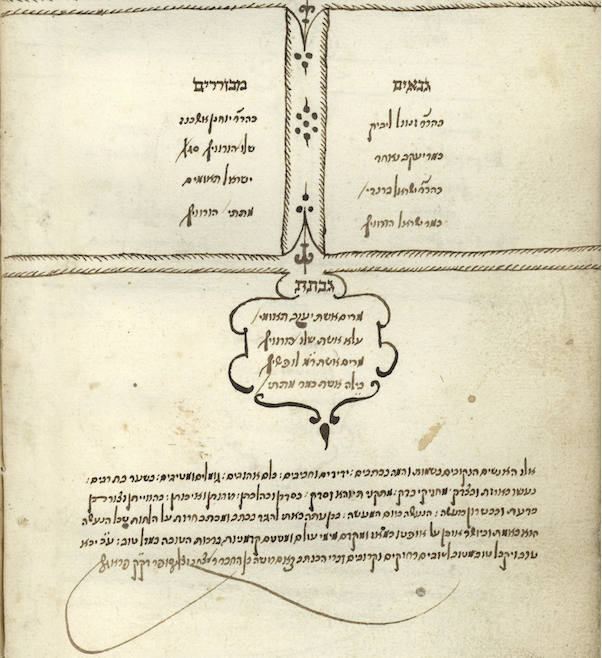
Many will be surprised to learn that in some communities in early modern Ashkenaz, women’s daily attendance at synagogue for morning and evening prayers was normative and encouraged. As a matter of course, women received formal honors there. Seen here, a list of male gabba’im and mevorarim (top) and female gabbetes (center). Logbook of the Pinkas synagogue Prague, 1621
© Archives of the Jewish Museum in Prague, Pinkas synagogue collection
This turn to literacy impacted women at different societal levels, and more and more women expressed themselves as readers, writers, learners and teachers. Roza, a midwife from Groningen, the Netherlands, kept a record book documenting the births she facilitated. She began it with Hebrew and Yiddish prose, alluding to the Biblical Jewish midwives in Egypt through the chronogram “Ani Ha-ha-meyaledet” (“I am the, the midwife”), whose Hebrew letters represent the year her career began. (The extra Hebrew letter hei was necessary for the calculation, resulting in the definite article appearing twice, a detail perhaps intended to reinforce her sense of self.) Roza also included her own prayer for the welfare of birthing women, that they deliver their babies easily “like an egg from a hen.” Beyond her midwifery and charitable deeds, and even her activities with converts, Leah Hindchen of Frankfurt’s contributions as darshanit and lamdanit, and her wide expertise in Chumash, Rashi and other mefarshim, were significant enough to be recorded. Modern readers will learn that the Bais Yaakov system did not invent the concept of women’s instruction in biur tefillah; Rivkah bat Shabtai Horowitz of Prague interpreted and expounded upon the machzor to other women in the sixteenth century. Nor did rebbetzins begin to field sensitive questions from constituents in recent years. Rebbetzin Shondlein (wife of Rav Israel Isserlein) and Rebbetzin Fromet (wife of Rav Yehuda Mehler) worked as partners to their husbands in the rabbinic process, enabling women to ask and receive answers to delicate halachic questions while preserving norms of modesty. These women were by no means unique, dwelling among many other similar women in societies that promoted and praised their contributions.
The sources abound with Jewish Ashkenazic traditions for women now obsolete. Many will be surprised to learn that in some communities in early modern Ashkenaz, women’s daily attendance at synagogue for morning and evening prayers was normative and encouraged. As a matter of course, women received formal honors there such as sandeket; in Worms, the sandeket would hand out cookies to the celebrants at a brit (or almonds, if the brit occurred on Pesach). A preserved manuscript of the Birkat Hamazon text reveals a liturgical convention no longer in practice: The text contains a superscript in Yiddish directing women to omit the phrase “ve’al beritcha shechatamta bivsarenu—And for Your covenant (brit milah) which You have sealed in our flesh.” Today, of course, this is a phrase women recite, regardless of the factual discrepancy. To signify the near-death experience endured during labor, a woman returning to synagogue after childbirth would wear shrouds over her clothing, which she would then remove. Another source describes the synagogue visit at the end of her lying-in period as Shabbat Yetziat HaYoledet, an occasion commemorated with a formal celebration, including the granting of an aliyah leTorah to her husband.
Numerous traditions surrounded communal participation in the preparation of a bride on the eve of her wedding, including “kallah flechten,” a ceremony in which married women, beginning with the rebbetzin, would come to braid the hair of the bride and shower her with gifts. An entire genre of songs, known as “kallah lider,” served as the musical backdrop to this process.
Yet the work represents not merely a catalog of these historical riches, but their careful curation by expert hands. The authors weave the discrete bits of information together thematically, beginning with the function of women’s lives as active members of their communities. Leading the reader by the hand, they do not merely introduce us to the gabbete Rivka Devorah, likened on her tombstone to the Biblical Abigail, but contextualize her life within the development of women’s Hevrot, sacred societies that formally addressed various individual and communal needs. In meeting Traune, Yetche and Dossia, we learn not only of their individual marital arrangements, obligations and quarrels, but of the ways that neighborly relationships influenced communal life and even rabbinic decisions. The book is organized from cradle to grave, concluding with the transcendent categories of spirituality and religious rituals.
Thanks to Professors Kaplan and Carlebach, anyone even marginally interested in Jewish history can access the ways Ashkenazi Jewish women of the early modern period lived, died, argued, married, wrote, did business and nearly everything in between.
Connoisseurs of rabbinic literature will revel in the engaging exploration of rabbinic sources pertaining to women. A fascinating citation of Luchot HaEdut by Rav Yonasan Eybeschutz highlights the importance of women’s presence in communal records in one of the most famous rabbinic controversies of the day. In response to Rav Yaakov Emden’s attack on his amulets, Rav Eybeschutz cites the pinkas (historical ledger) of the burial society of Metz, and the sharp decline in instances of maternal death in childbirth, as proof of his amulets’ efficacy. Utilizing their access to these rare archival materials, the authors reviewed the pinkas to assess whether the names of those women who died in childbirth were also listed there.
From Rav Yaakov Emden’s exhortation in Birat Migdal Oz that girls be educated by proficient women and not men, the authors derive the prevalence and availability of such expert women. A she’eilah extended to Rav Yehuda Mehler on the possibility of shatnez conveys women’s commercial reach: At least one woman’s livelihood, in the trade of thread, led her to travel from country to country for more than twelve years. Another query to the same source is offered by the notable Reizshe, and it concerns the creation of an eruv between her home and that of her son-in-law; in seeking halachic resolutions, the conditions of her life become apparent, as does the extent of women’s privacy within multigenerational living spaces. Shu”t Yefeh Nof, a compilation of responsa by Rav Yitzchak Mi’Zia, lifts the veil covering the lives and practices of Jewish women in sixteenth-century Ashkenaz. The questions posed to him illuminate a variety of topics relevant to women, from the regional variation of bridal sums explicated in the ketubah to a woman’s illicit correspondence as constituting evidence of adultery, to monetary disputes with maidservants over laundry.
One arguable point raised by the authors concerns the popularity of the Shtar Chatzi Chelek Zachar, a halachic contractual innovation enabling women to receive a portion of their father’s inheritance. The authors correlate the standardization of this practice with the dissemination of the contract in printed form. Yet the statement of Rav Moshe Isserles attesting to the popularity of the Shtar Chatzi Chelek Zachar “that is currently in practice” suggests that its use was already widespread at the time of the publication of his Mappah on Even Haezer. This, however, is precisely the type of debate that halachic enthusiasts will gleefully explore.
For those most attuned to the historiographical timbre, the distinguishing feature of this work lies in its analysis, namely its presentation of a new historical framework with which to assess Jewish life in the early modern period. Countering the paradigm of ghettoization and subsequent liberation, the authors situate women’s lives and deeds within the context of the early modern kehillah. As the kehillah and its internal mechanisms evolved, lay members became increasingly involved in recordkeeping and preservation, and references to ba’alei bayit abound in communal logs and documents. Their female counterparts, the ba’alot bayit, similarly appear in communal literature, and the book breaks new ground in documenting their various activities. In this way, the book brings women out of the ghetto of historiographical invisibility, clearly demonstrating the vibrant and productive presence of women in Jewish life.
The most significant takeaway from the work is the totality of Jewish women’s achievements in their respective societies. Historians and conventional wisdom have long contended that women in early modern times were limited in their reach and influence, and other than several conspicuous stars, unworthy of note or recollection. This book upends that narrative once and for all, showing the myriad ways that women produced and thrived for centuries as a collective of talented individuals. In compiling, categorizing and considering early modern records with an eye toward the experiences of Jewish women, the authors—themselves greatly accomplished Jewish women—have answered the call that begs for their ancestors’ remembrance. In so doing, Professors Kaplan and Carlebach have masterfully restored not only one individual woman’s story, but those of a multitude of women, thus constituting the revival of an entire era.
Notes
1. See Megillah 7a.
Rebbetzin Dr. Tzipora Weinberg is scholar in residence at the Walder Foundation, creator and host of the Veiled Reference podcast and rebbetzin at K’hal Lev Avos in North Woodmere, New York.