
Israeli Aspects of the Eichmann Case

As Israel prepares to bring the perpetrators of October 7 to justice, the Eichmann trial resonates with renewed urgency. Jewish Action is proud to republish these remarkable essays from Jewish Life, written in 1960 following Eichmann’s capture.
 In this column, we dive into the rich history of Jewish Life, the precursor to Jewish Action. Published by the OU from the 1940s to the 1980s, Jewish Life offers a unique window into the vibrant evolution of American Jewish life during the 20th century.

The article below appeared in the August 1960 issue of Jewish Life.
Jerusalem
It can surprise no one that Israelis regard the abduction of Adolf Eichmann by Israel agents in Buenos Aires in a totally different light from that in which it is seen, not only by Argentinians, but by other nations of the world. For Israelis and for Jews generally Eichmann is a self-confessed monster, who said of himself in 1944, “I shall jump into my grave laughing because the fact that I have five million Jews on my conscience gives me extraordinary satisfaction.” It is difficult for the Israeli man-in-the-street to conceive that for Eichmann normal canons of law and legal procedure continue to apply. This is the crux of the judicial quandary in which the State of Israel finds itself now that he is safely under lock and key. The weight of evidence is so overwhelming—Eichmann, unlike other Nazis, does not seem to have made any attempt to cover up the traces of his crimes, probably because of their magnitude, but also because of his conviction of ultimate Nazi victory—that his arraignment before an ordinary court of law seems an unnecessary formality. Out-of-hand assassination, there is no doubt, would have been regarded far more sympathetically by world opinion, as an act of justice and not merely of revenge, than to make him stand trial before a properly constituted court of law. Indeed because of the inevitability of the verdict Israel’s determination to observe the forms of law is being spoken of as exploitation of the occasion to stage a show trial.
Israel’s jurists, needless to say, are resolved that all legal proprieties shall be observed in the case of Eichmann and that not only shall justice be done, but that it shall be seen to be done by the whole world. Pinchas Rosen, Minister of Justice, is waging a valiant though unequal battle against prejudgment of the case in the press, but his pleas that the issue is sub judice and that certain press comment constitutes contempt of court have proved unavailing. There have even been reports of a quarrel in the Cabinet between Mr. Rosen and the Prime Minister over the statement made in the Knesseth on the seizure of Eichmann. Mr. Rosen is said to have protested against Mr. Ben-Gurion’s use of the phrase, “one of the greatest Nazi war criminals . . . who was responsible together with other Nazi leaders for what they called the final solution of the Jewish problem.” This, Mr. Rosen insisted, is precisely what the Israel courts will have to decide.
The Israel law under which Eichmann will be tried, The Nazi and Nazi Collaborators (Punishment) Law, legislated in 1950, is one of the two in the Israel legal code—the other is treason in time of war—for which the death penalty has been retained despite the abolition of capital punishment. The first paragraph of this law says that persons who during the period of the Nazi regime committed crimes against the Jewish people, or against humanity in general, or who during the Second World War committed war crimes, shall be liable to the death penalty. A crime against the Jewish people is defined as the commission of any of the following acts with the intent of destroying the Jewish people in whole or in part:
—killing Jews
—causing serious bodily or mental harm to Jews
—placing Jews in living conditions calculated to bring about their physical destruction
—institution of measures to prevent births among Jews
—forcibly transferring Jewish children to another national or religious group
—destroying or desecrating Jewish religious or cultural assets or values
—inciting to hatred against the Jews.
Under this law a number of persons, mainly Jews who served as Kapos in the concentration camps or former members of the Jewish police in the ghettos, were brought to trial and sentenced to terms of imprisonment.
Legalists in other countries have questioned the right of Israel to try Eichmann not only because of the manner of his arrest, but because the crimes with which he is being charged were committed outside Israel at a time when the State of Israel was not yet in existence. International jurists are having a field day discussing the finer legal points of the case, but it is already clear that adequate legal precedents were established in the war criminals trials—if, indeed, this question should be relevant in the present instance.
Closely integrated in all this legalistic argument is the suggestion that Eichmann should be tried by an international court, highlighted by the angry exchange of letters between David Ben-Gurion and Dr. Nachum Goldmann on this point.
What is supremely important is the full exposure of the Nazi regime’s atrocities against the Jewish people.
Dr. Goldmann’s position as president of both the World Zionist Organization and the World Jewish Congress make him far more sensitive to world opinion than Israelis normally are. His suggestion that Eichmann should be tried by an international court, in Israel and presided over by an Israeli, to which all countries, including the USSR, which suffered under the Nazis, should appoint judges, stems from a closer rapport with feeling outside Israel and a desire to forestall sneers about “Old Testament justice.” The appointment of such a court, he has said, would be a laudable and useful gesture, stressing the bond between all those, Jews and non-Jews, who suffered under the Hitler regime. Ostensibly Ben-Gurion’s protest was against publication of the suggestion without prior consultation with the Israel Government, but of course the main cause of his resentment was the force it lends to the considerable body of international opinion that is still pressing for the trial of Eichmann by non-Israelis. Insisting that historic justice and the honor of the Jewish people make it imperative that Eichmann should be tried by an Israel court, Mr. Ben-Gurion has declared that it is not the guilt of Eichmann and the penalty to be imposed that is the main thing, for no penalty can be commensurate with the crimes he has committed. What is supremely important is the full exposure of the Nazi regime’s atrocities against the Jewish people.
It is precisely because Nazism and not only Eichmann will be in the dock that the trial is being awaited with some apprehension. The probity of Israel justice, even where the highest placed personalities are involved, cannot be challenged, but the tendency among many Israelis—fortunately not shared by official circles—to brush aside the insistence upon proper legal procedure as so much hair-splitting must give rise to concern. An obsessive sense of justice, as a result of which Eichmann will finally be brought to book, has induced carelessness in such secondary aspects as procedure and publicity.
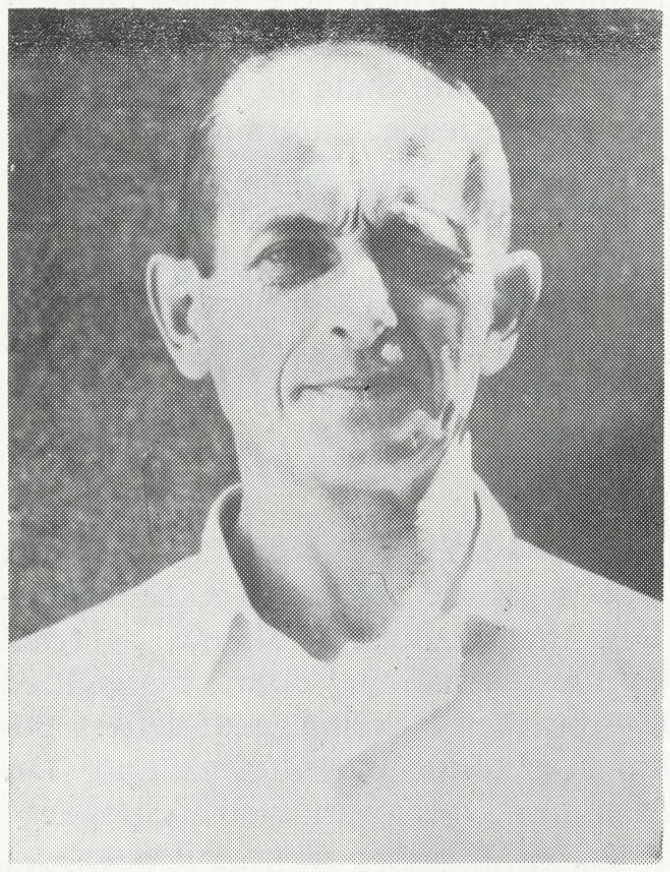
This is the first official photograph of Adolf Eichmann which was released by the Israel government.
The Tracing and arrest of Eichmann constitute by all standards a brilliant exploit, but if the official statement made in the Knesseth had been a little more carefully worded much unnecessary embarrassment and tension might have been avoided. It seems to have been based upon a peculiar dual assumption that the world press and public opinion would leave the matter rest where the statement left it and that Israel’s extra-legal methods in seizing Eichmann would be excused because of the enormity of his crime. There are a number of parallels with the U-2 incident which officially at least torpedoed the Summit Conference in Paris. There was a similar infringement of territorial sovereignty on the plea of overriding national interest and the same candor of the heads of government in acceptance of full responsibility for the incident. It is, of course, not customary for a prime minister to acknowledge the operations of his secret agents and there was no reason for Mr. Ben-Gurion to be so frank in doing so. Then again someone among the Prime Minister’s advisors has a low opinion of newspapermen and their ability to get the information they are after. Less than a week after an official Israel statement that the country in which Eichmann was taken and the circumstances of his arrest would never be known, an account clearly correct in all essentials was published in Time magazine.
The scope of the case and the widespread interest it has aroused throughout the world indicate certain pitfalls which Israel must avoid. The Prime Minister has said that it will expose the extent of Nazi crimes against the Jewish people. From the 06 Bureau in charge of the investigation has come a statement that preparation of the case will take at least six months. But if the trial is to have the proper historic impact, if public interest not only among the Jews, but in the world generally, is to be sustained it must not be too long drawn-out. The proceedings, it can be foreseen, will be dramatic enough, the interest keen and attendance large, and passions will run high. To allow the public to follow the trial, Jerusalem’s largest hall, the Binyaney Ha-umah, will be taken over. Taking all this into account every precaution must be adopted to keep out any theatrical note. Not only Eichmann but Israel’s justice will be on trial.
Tuvia Friedman, Director of Historical Documentation, in his Haifa office, with documents concerning Nazi war criminals. Friedman was responsible for the collection of evidence which led to the charges of genocide being brought against Eichmann.
For these reasons jurists here are opposed to the appointment of any special court to try the case. Eichmann will most probably be tried by an ordinary District Court composed of three judges, though it is reported that the Minister of Justice is considering the appointment of a judge of the Supreme Court to preside—which he has the power to do in keeping with regulations dating back to the Mandatory administration.
Not only Eichmann but Israel’s justice will be on trial.
One difficulty will have to be surmounted: the appointment of defense counsel, to which even Eichmann is entitled. No Israel lawyer is likely to undertake so obnoxious a task. Special legislation will be necessary to allow non-Israeli lawyers to accept the brief. Several offers to undertake Eichmann’s defense have been received from foreign lawyers, most but not all of whom are Germans. The choice will be left to the accused man himself. The only restriction that the Israel authorities will impose is that counsel must not have committed war crimes or crimes against the Jewish people or humanity, though no legal objection will be raised if he is a former Nazi. The Eichmann family is retaining Dr. Robert Servatius, a Cologne lawyer, who defended a number of Nazis at the Nuremberg trials. Dr. Servatius has served in the German army but has stated that he was never a member of the Nazi Party and that his interest in the case is legal and not political.
Another difficulty that may arise is in regard to defense witnesses, if the same prohibition on persons guilty of crimes against Jews or humanity applies.
Should Eichmann be found guilty there is only one possible sentence—death. But in neither of the two crimes on the Israel legal code for which capital punishment has been retained, has any provision been made for the manner of execution or for the office of executioner.
The arrest of Eichmann and especially the international complications which have resulted have underlined the well-known fact that many Nazi war criminals are still at large and filling top-level positions in Germany and elsewhere. The Oberlander case has proved that active participation in the slaughter of Jews does not constitute a moral obstacle to political advancement in post-Hitler Germany.
Another sidelight is that the Argentine and the United Arab Republic are the twin termini of a Nazi escape route. In Egypt Dr. Von Leers, formerly on Goebbels’ staff, is Nasser’s expert on anti-Jewish propaganda. Dr. Eisele, wanted for “medical experiments” conducted in the Buchenwald death camp, has found a refuge in Egypt as has Dr. Ludwig Zind, a schoolmaster of Hesse, who was found guilty of making Antisemitic remarks in front of his pupils, but somehow managed to escape before he was sent to jail. And of course there is a large contingent of former Nazi officers training the United Arab Republic army. There is an affinity of many years standing in the approach of the Germans and the Arabs towards the Jews. The former Grand Mufti, Haj Amin al Husseini, it is known, urged Hitler to accelerate his plans for the “final solution of the Jewish problem.” Rashid al Gilani (today under sentence of death in an Iraqi prison, this time for trying to assassinate the dictator General Karim Kassem) celebrated his overthrow of Nuri e-Said during the Second World War by a massacre of Baghdad’s Jews. And judging from the repeated pronouncements of responsible Arab leaders, genocide is never far from their minds.
There is no contradiction between the fairly cordial relations which have subsisted between Israel and the Argentine—now restored by the settlement of the dispute as to the infringement of Argentine sovereignty—and the fact that a large number of Nazis have found a refuge in that country. International relations often present these paradoxical situations. German and Antisemitic influences are strong in the Argentine and it was largely due to pressure of such a group, exploiting the absence of President Frondizi in Europe, that the tension between the two countries was blown up to unwarranted proportions. Certainly if the Argentine authorities had been interested in apprehending Eichmann it would never have developed. Argentina has a simple policy in regard to the war criminals resident within its borders. Requests for extradition, even where agreements cover this category of crime, are either pigeonholed and ignored, or met with a statement that no person of the name specified is to be found—as in the case of Adolf Eichmann alias Ricardo Clement—or given so much publicity by the police that the wanted man has adequate warning to move on to some other accommodating country—as in the case of Dr. Josef Mengele, who as “medical officer” of Auschwitz, decided which of the incoming prisoners was capable of manual labor and which must be sent straight away to the gas chambers, and who, it was reported recently, had moved hurriedly to Chile.
The Eichmann trial will bring much of this sort of information to light, especially if he decides to talk. There are already reports of new arrests in Germany, including the re-detention of persons previously brought to trial but released for “lack of evidence.” In the Arab countries, too, the possibility of revelations at the trial is not relished. A rehearsal of the close collaboration between Arab leaders and the Axis powers during the Second World War can prove uncomfortable.
With the exception of the extraordinary precautions taken in guarding Eichmann, both against the possibility of escape and an attempt by some revenge-crazed victim of his who has somehow survived to settle accounts with him personally, his conditions in prison do not differ materially from those of other prisoners. He is kept in a cell nine meters square. Three squads of warders have been detailed to guard him—one, unarmed, inside the cell together with the prisoner, another, armed, outside the cell, and the third, in charge of supplies for the prisoner and the warders—for Eichmann gets the same rations as his guards. Precautions have been taken against poisoning and suicide. Eichmann is permitted to shave with an electric razor, while each of his four daily cigarettes is lit for him by his guard inside the cell, who then hands the matches to the guard outside. None of his guards knows German and all are under strict orders not to communicate with him.
Eichmann is being treated according to the rule laid down by Judge Jackson during the trial of war criminals by the International Military Tribunal at Nuremberg, namely that the accused must benefit from the presumption of innocence.
Halevy-Levin, Jewish Life’s Israel correspondent, provides readers with discerning insights into developments on the Israel scene.