
A Legacy Rekindled in Kharkiv: An OU Kiruv Initiative That Impacted Generations
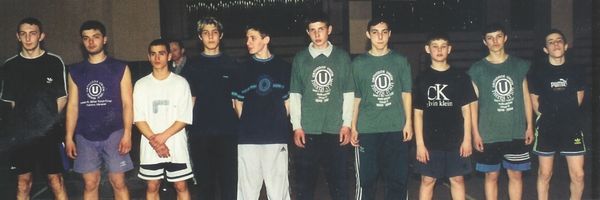
The OU-sponsored Sha’alvim school and summer camp were vibrant, bustling institutions where young Jews experienced authentic Jewish life for the first time.
Most of us recognize Kharkiv—or its old Russian name, Kharkov—from the headlines. Located just nineteen miles from Russia’s border, Ukraine’s second-largest city has been the scene of fierce fighting in the still-ongoing war.
But Kharkiv has another story—a quieter, more hopeful one. Beginning in 1990, the city became home to a unique OU-funded kiruv initiative that spanned nearly two decades and ultimately shaped the Jewish futures of hundreds of young people.
The OU-sponsored Joseph K. Miller Torah Center, along with the Sha’alvim school and summer camp, are no longer operating. But in the years following the fall of communism, they were vibrant, bustling institutions where young Jews experienced authentic Jewish life for the first time.
“It [the OU’s programs] changed my whole life,” says thirty-eight-year-old alumna Esther Lavie. “Without it, I would have stayed in Ukraine and intermarried.” Now living in Tel Aviv, Lavie—a special education teacher and mother—didn’t know she was Jewish until age eleven. Today, her husband is learning in a kollel.
The OU’s Kharkiv story dates back to 1990, when then–OU president Professor Shimon Kwestel joined lay leader Joe Alpert, Rabbi Raphael Butler—then NCSY’s national director—and singer Shlomo Carlebach on a mission to what was then the Soviet Union. Along with visits to major cities and concerts by Shlomo Carlebach, they installed a Torah scroll—written in memory of Joseph K. Miller—at the Kharkiv synagogue. An active OU board member, Miller had been deeply involved in the cause of Soviet Jewry before he was killed in the 1988 bombing of Pan Am Flight 103 over Lockerbie, Scotland.
“Thousands of people turned up [to the Torah dedication],” recalls Kwestel. “I saw that we needed to do something.” That “something” became a kiruv camp, which opened its doors in the summer of 1991.
One of the great rabbanim of the late twentieth century is reported to have said that “every generation will be judged by a singular event. Our generation will be judged by how we dealt with Soviet Jewry.”
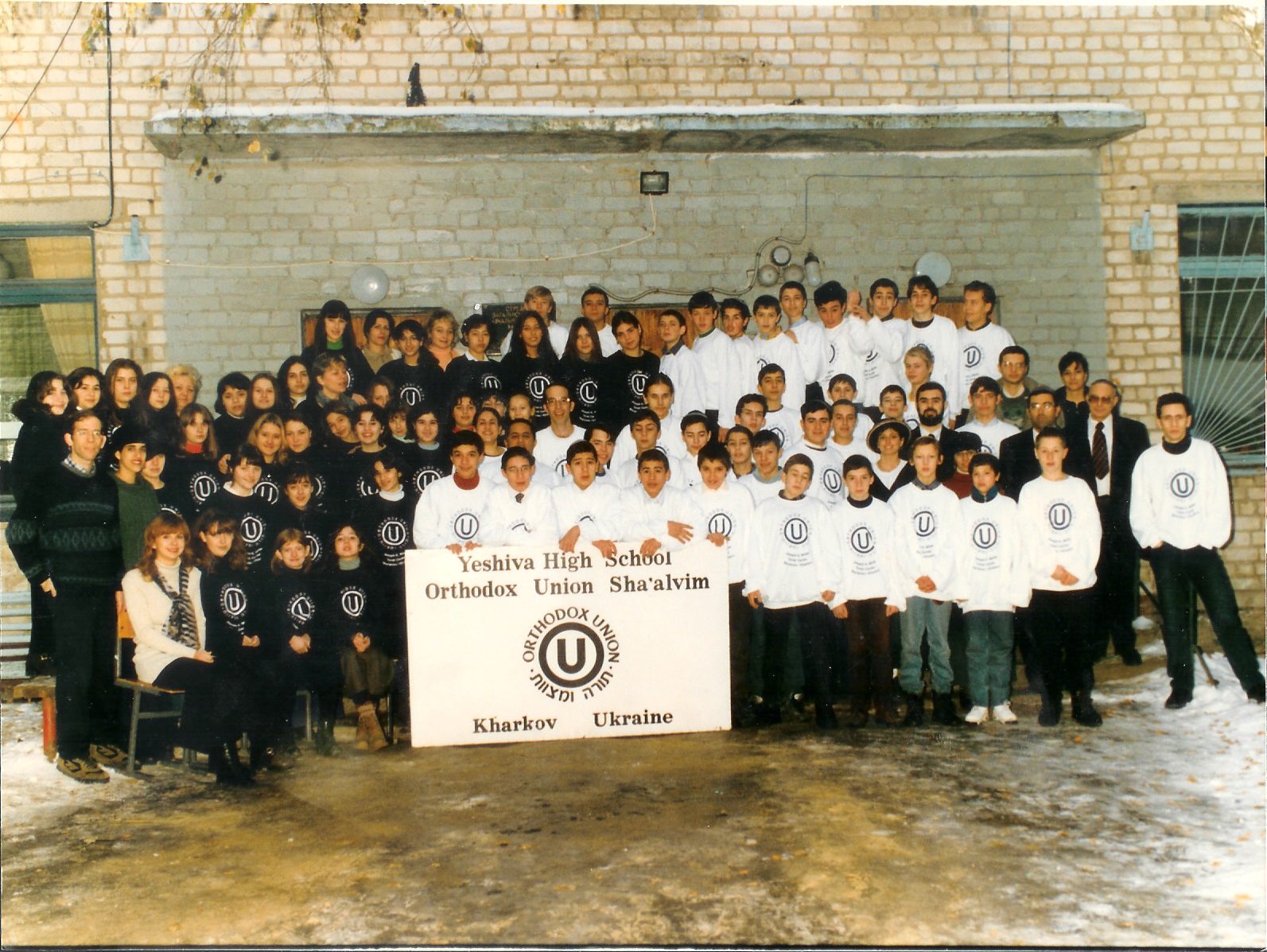
Beginning in 1990, Kharkiv became home to a unique OU-funded kiruv initiative that spanned nearly two decades and ultimately shaped the Jewish futures of hundreds of young people.
The OU took that mandate to heart.
Located in the countryside near Kharkiv, the camp was far from luxurious—there were swamps and mosquitoes—but it gave participants a genuine spiritual high. “The OU shipped in food and sent a mashgiach to make sure it was properly prepared,” recalls Kwestel.
Counselors were recruited from among American teenagers in NCSY’s Jewish Overseas Leadership Training (JOLT) program and Israeli yeshivah students from Sha’alvim. Sha’alvim’s Diaspora program was led at the time by Rabbi Mallen Galinsky, who became the OU’s key partner in Kharkiv.
Neither campers nor staff were deterred by the modest accommodations. The two-week camp, which attracted approximately 500 participants each summer, ages twelve to twenty-six, was an overwhelming success.
Every generation will be judged by a singular event. Our generation will be judged by how we dealt with Soviet Jewry.
“There was so much love. We wanted to spend as much time with the staff as possible,” recalls Ariel Tarafula, who grew up in Kharkiv. Now an IT engineer raising a Jewish family in the United States, Tarafula continued attending the camp even after aging out. “There was a special atmosphere,” recalls former counselor Oshrit Moti, a mother of six and a coordinator for Israeli National Service girls, who spent five summers there. “The kids didn’t know anything. They ate non-kosher food. Most of their fathers weren’t Jewish,” she recalls. “We stood on tables and taught them Jewish songs and prayers.”
For Tarafula, the camp was also where he formally cast his lot with the Jewish people by undergoing a brit milah. “The counselors held my hand and supported me. Everyone was so kind,” he recalls.
Following the camp’s success, the OU expanded its presence in the area, purchasing and renovating several apartments in Kharkiv to establish the Joseph K. Miller Torah Center. The OU recruited Rabbi Shlomo Asraf from Israel to lead the programs. A Sephardic Jew from Netanya, Rav Shlomo—as he was known—had a natural gift for kiruv. Though he spoke neither Yiddish nor Russian, he had already founded a synagogue and kiruv center in Moscow. He proved to be exactly the right man for the job. “Rav Shlomo lived and breathed Kharkiv,” recalls Kwestel.
“Rav Shlomo brought with him the spirit of Eretz Yisrael and Torat Yisrael,” recalls Moti.
It wasn’t long before Rav Shlomo became fluent in Russian. Under his leadership, the Torah Center operated nearly around the clock. “There were Shabbat services, classes for university students, and Pesach Seders so large that we needed to rent an auditorium,” recalls Kwestel. Rav Shlomo remembers packed Rosh Hashanah services and a Chanukah concert that drew more than 1,000 people.
He also established a day school. “We started with fifty students,” he recalls. “At its peak, we had 250 kids from grades one through eleven.” The school’s goal, he explains, was to prepare students for aliyah—and it succeeded. Nearly 600 graduates eventually made aliyah, assisted by the OU Israel Center in Jerusalem. “[Today], our graduates live all over Israel. Many became religious and established religious families,” says Rav Shlomo.
Today, the Torah Center, camp and school stand empty, as many of Kharkiv’s Jews have emigrated—most notably to Israel. Yet the legacy endures. “I am still in touch with many of them,” says Rav Shlomo. Several months ago, he officiated at a wedding. “The mother had been one of our graduates. Now I was officiating at the chuppah for her daughter.”
“This is success,” observes Alan Miller, a former OU CFO and Joseph K. Miller’s son.
“One generation later,” he adds, “students, shelichim, counselors on JOLT, and even individuals like myself still feel the kiruv effectiveness and impact left by Rav Shlomo.”
Carol Ungar is an award-winning writer whose essays have appeared in Tablet, the Jerusalem Post, Ami Magazine, Jewish Action and other publications. She teaches memoir writing and is the author of several children’s books.
In This Section
Under Fire They Came Home: How War Is Drawing Ukraine’s Jews Back to Jewish Life by Carol Ungar
A Legacy Rekindled in Kharkiv: An OU Kiruv Initiative That Impacted Generations by Carol Ungar
The Bread of Affliction That Also Brings Hope by Carol Ungar