
The Bread of Affliction That Also Brings Hope
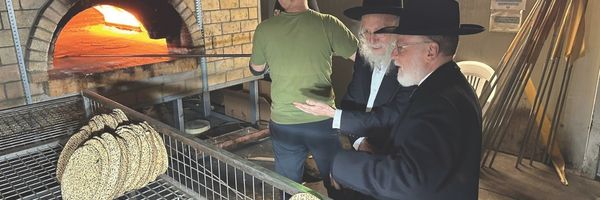
A matzah bakery in Bucharest, Romania, provides essential employment to refugees forced to flee Odesa during the Russian bombardments of Ukraine.
For the refugees of Ukraine, hope is now found in a box of matzah.
For the displaced Jewish community of Ukraine’s Tikva Children’s Home, a new brand of handmade shemurah matzah—Ateres HaMatzos / Matzos Bucharest—is more than a kosher staple; it is a vital lifeline. This year, as the matzah takes its place on grocery shelves, it is also providing essential employment to the very people who were forced to flee Odesa during the Russian bombardments of Ukraine.
“It’s really meaningful to buy these matzos because they support an entire community,” says Zevy Wolman, an OU Board member who has been helping to bring the matzah to the US market.
The 1,200-member Tikva community grew out of the Tikva Children’s Home, founded by Rabbi Shlomo Baksht. In 1996, newly arrived in Odesa, Rabbi Baksht discovered that hundreds of Jewish children were living in government-run institutions or surviving on the streets. Many had been abandoned by parents struggling with addiction, mental illness or the sheer inability to care for them. Their futures seemed bleak.

Rabbi Ethan Katz, director of OU Relief Missions, visited the matzah bakery with his volunteer group during a mission this past December.
To change that trajectory, Rabbi Baksht established Tikva—which means hope—giving these children a chance for a new and better life.
Over time, Tikva evolved into a comprehensive school system with dormitories that have provided schooling and a home to hundreds of children from Ukraine, Belarus and Moldova.
In March 2022, as Russian bombardments intensified, Tikva’s CEO, Rabbi Refael Kruskal, concluded that Odesa was no longer safe. Under his leadership, the entire Tikva community—including former students, teachers and 250 orphans—evacuated by bus to Romania.
Today, Tikva is based in Bucharest, where it continues to care for roughly 300 orphans.
“It’s a unique community, the only real Orthodox community that left Ukraine and stayed together,” says Tikva volunteer Menachem Siegal.
But for community members, making a living is a huge challenge. “There isn’t enough employment in Bucharest. Not having work makes people depressed. We didn’t want that to happen. We wanted our people to be able to support themselves,” says Rabbi Kruskal.
This is why the matzah bakery—providing up to seven months of steady work each year—has become essential.
“There is no one making money on this matzah. It’s a nonprofit—the entire motive is to support the community”
Housed in an 8,000-square-foot warehouse in Bucharest, the bakery, opened three years ago, currently employs forty adults, helping them earn a living wage that offsets basic expenses. “This gives people the ability to feel independent; even if it’s 30 to 40 percent of what they need to live for a year, it’s better than being completely dependent on tzedakah,” says Wolman.
Israeli mashgichim trained community members in matzah production. The matzah is supervised under the Kedassia certification—a stringent kosher certification in the UK—and by the US-based Minchas Chinuch-Tartikov. Today, the bakery produces around 600 pounds of matzah a day. With the help of Network for Kindness—an association of US-based Tomchei Shabbos organizations and food pantries—in partnership with the OU, the bakery is exporting more than 60,000 pounds of matzah to the US for the first time. Network for Kindness and the OU have leveraged their institutional reach to ensure that the matzah makes its way onto the shelves of kosher grocery stores, into food pantries, and into Tomchei Shabbos packages—creating a vital market for the bakery’s work.
The bakery also sells some 20,000 pounds to Jewish communities in England, Vienna, France, Belgium and other countries. But this is the first year the matzah is being marketed in a major way. “It’s a much bigger operation this year,” says Siegal. The goal, he explains, is to keep the bakery open year-round and employ community members throughout the year.
“There is no one making money on this matzah. It’s a nonprofit—the entire motive is to support the community,” says Siegal.

Israeli mashgichim have trained community members in matzah production.
Everyone Here Is a Refugee
Back in 2022, the evacuation to Romania was an urgent necessity; the community’s rabbi ruled that it was pikuach nefesh. “They left on Shabbos in the middle of the night,” recalls Rabbi Shlomo Noach Mandel, executive director of the Shema Yisrael school network, of which Tikva is a part.
“Getting them into Romania wasn’t easy,” he says. There were many bureaucratic hurdles, as many of the children were officially registered as Ukrainian wards of the state.
While aliyah might have seemed like the natural solution, Tikva’s administration ruled it out. “We wanted the orphanage and the community to stay together. In Israel, that would have been impossible,” says Rabbi Kruskal.
In Bucharest, community members live, study and work side by side in one small neighborhood, recreating the warm atmosphere that characterized Tikva in Ukraine. Though Tikva’s mission is not formally kiruv, many children—most from nonreligious, single-parent homes—find their way back to Jewish life through the care, stability and Torah environment Tikva provides.
Since the evacuation from Odesa, the OU’s Relief Missions department, headed by Rabbi Ethan Katz, has been sending volunteers from the US and Israel to bring joy and connection to the Tikva children. High school students, college-age youth and young professionals arrive brimming with energy. They run carnivals, lead craft projects, organize spirited Shabbat meals, and—most importantly—build genuine relationships.
“It’s the highlight of these kids’ lives,” says Rabbi Katz, a much-beloved figure among the Tikva youth, who has organized more than a dozen volunteer missions to the orphanage.
“The children at Tikva are surrounded by care, stability and genuine love every day,” says Rabbi Katz. “Many come from backgrounds where their natural homes could not provide that and the war only intensified their trauma. When people travel from around the world on relief missions to see them, it adds an extra and powerful dimension of love and affirmation—something they did not experience in their early lives. Many of these children are carrying significant PTSD, and knowing that the world sees them, values them and cares deeply about them makes a profound difference.”
As difficult as the upheaval has been for the children, the transition has often been even harder for the adults. Few speak Romanian; meaningful employment is scarce; and what was expected to be a short relocation has stretched into years, leaving the Children’s Home under severe financial strain.
“Everyone there is a refugee,” says Rabbi Katz. “When you buy this matzah, you are literally buying hope,” he says.
Carol Ungar is an award-winning writer whose essays have appeared in Tablet, the Jerusalem Post, Ami Magazine, Jewish Action and other publications. She teaches memoir writing and is the author of several children’s books.
In This Section
Under Fire They Came Home: How War Is Drawing Ukraine’s Jews Back to Jewish Life by Carol Ungar
A Legacy Rekindled in Kharkiv: An OU Kiruv Initiative That Impacted Generations by Carol Ungar
The Bread of Affliction That Also Brings Hope by Carol Ungar