
 I Read This Over Shabbos: Reading Jewish History in the Parasha
By Rabbi David Bashevkin
Maggid Books
Jerusalem, 2026
508 pages
Rabbi Dovid Bashevkin gravitates toward controversy. The founder of 18Forty and host of its flagship podcast, and a close friend and colleague of mine as well as a member of Jewish Action’s Editorial Committee, he has a keen feel for what deeply interests and profoundly concerns today’s Jews. He publicly explores the boundaries of Orthodox Jewish society and the beliefs and insecurities of many people through an extremely popular conversation about the Jewish community. One pillar of Rabbi Bashevkin’s thought is that the Jewish present can only be understood, and the Jewish future can only be built, based on an intimate knowledge of Jewish history.
Someone who wants to add to scholarship writes a textbook. Rabbi Bashevkin wants to reach the broader public, so he wrote an engaging series of historical essays connected to the weekly parashah. Each essay uncovers fascinating historical episodes, often controversies, many of which reverberate today. These include debates over Rabbi Avraham Yitzchak HaKohen Kook’s speech at the inauguration of the Hebrew University, Rabbi Norman Lamm’s book Torah UMadda, the study of the plain meaning of the Torah, the Cleves Get, and much more. Rabbi Bashevkin shows the relevance of each historical episode to the parashah and to contemporary life. Using his characteristic personal anecdote and Chassidic Torah insight, as well as assorted historical pictures and documents, he makes the book light and welcoming. Each chapter ends with suggested Shabbat reading to explore the subject further.
In Rabbi Bashevkin’s capable hands, Jewish history becomes Jewish guidance for the masses, Shabbat afternoon reading that will entertain, inform and inspire. As mentioned, I work closely with Rabbi Bashevkin and often disagree with him on minor and major issues. I also see up close how he manages to balance scholarship with accessibility, education with entertainment, and the personal with the communal. The ongoing challenge of adult education in this age of distraction is getting the broader public interested in complex ideas. I Read This Over Shabbos is a masterpiece of Jewish education that should be studied by the public for its insights and by educators for its methodology. This book is 18Forty at its best. It offers readers an inside view of the Orthodox community’s struggles over leadership, philosophy and innovation as a way of seeing the messiness of successful community building.
 You, G-d & Me: The Divine Importance of Interpersonal Relationships
By Rabbi Allen Schwartz
Mosaica Press
Beit Shemesh, 2024
153 pages
Too many people think that Judaism primarily values ritual observance. In You, G-d & Me, Rabbi Allen Schwartz, rabbi of Congregation Ohab Zedek in Manhattan, argues at length that while the Torah values both ritual and interpersonal commandments, it considers the latter more important. Rabbi Schwartz proves his point in forty-two brief chapters, each grounded in specific Biblical passages. The first chapter asks: Why did the generation of the Flood die while the generation of the Tower of Bavel suffered only dispersion? The former treated people poorly and were punished more harshly, while the latter rebelled against G-d and were allowed to live.
Traveling across the Torah, Rabbi Schwartz adduces proof after proof for his simple yet counterintuitive thesis. One might think that proper interpersonal behavior is obvious and necessary for society to function. Why would religion need to teach those lessons, much less enforce them through Divine reward and punishment? There are many possible answers to this question, some of which go to the core of Revelation and its purpose. Rabbi Schwartz’s effort suggests a simple and profound reason: Without interpersonal commandments, we might think that ritual takes priority, that our obligations to our Creator override our obligations to our fellow human being. The Torah needed to clarify the opposite. As Rabbi Schwartz emphasizes, this does not minimize the importance of ritual commandments, which remain crucial. Nor does it translate directly into practice, which requires consultation with a rabbi. Rather, it informs our priorities so we maintain proper focus.
A careful reader of this book will see that Rabbi Schwartz handles texts and sources with great expertise. He reads Torah together with the Sages and classical Jewish commentaries. And when he quotes these texts, he almost invariably includes a new insight. Rabbi Peretz Steinberg, as a young man, once visited Rabbi Eliezer Yehuda Finkel, rosh yeshivah of the Mir in Jerusalem. Rabbi Finkel was prepared to miss the nightly Maariv service in yeshivah in order to serve his guest, until the visiting student promised to remain, so the rabbi could show him hospitality after davening. Combining a statement of the Sages about Avraham leaving G-d’s presence to greet the three strangers (Bereishit 18:1) with a Rashi about G-d’s presence being stricter than prayer (Shemot 12:1), Rabbi Schwartz justifies Rabbi Finkel’s willingness to place hospitality above proper prayer. Throughout the book, new perspectives on classic texts are interspersed among the arguments, offering a vibrant study of Jewish thought in pursuit of the main thesis. Like a master teacher imparting well-crafted lessons, Rabbi Schwartz effortlessly teaches us on Biblical, rabbinic, halachic and homiletical levels the religious importance of caring for others.
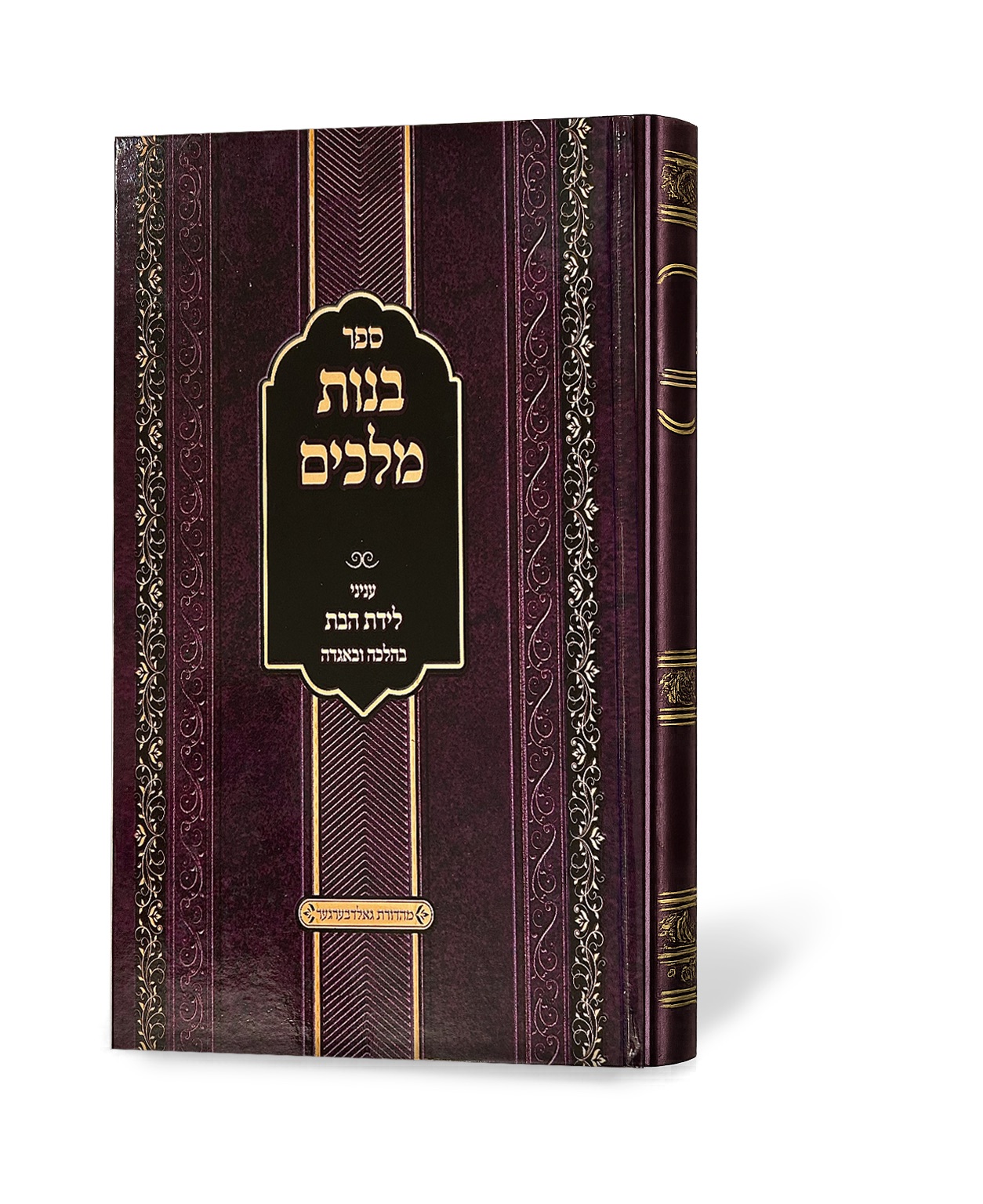 Benot Melachim: Inyanei Leidat HaBat BeHalachah UveAggadah
By Rabbi Yechezkel Moskowitz
2023
518 pages
The birth of a child is among the most meaningful and joyous occasions of a person’s life. When the baby is a boy, everyone knows that the family arranges for the baby to be circumcised. The process is straightforward and expected. What about when a baby girl is born?
Rabbi Yechezkel Moskowitz’s Benot Melachim manages to fill a lengthy volume discussing this topic which seemingly has little precedent. His method is familiar but adapted to this unusually sparse topic. The book begins with an approximately fifty-page halachic section on ten topics related to childbirth in general and specifically the birth of a daughter, beginning with the blessing recited over the joy of birth and continuing through the baby’s naming and a kiddush served in honor of the daughter. These sections push the boundary of related halachic issues and relevant opinions, presumably in order to maximize the size of this section. The nature of such collections is to include a wide variety of opinions.
Next there is an over-400-page section consisting of small quotations from a wide variety of texts, arranged by topic. For example, there are twenty-one pages of quotations about the Mi Shebeirach prayer recited during the baby’s naming. These passages address a variety of issues, of which the most contentious is whether to state that the parents should merit to raise the girl to “Torah” along with “chuppah u’ma’asim tovim.” The author quotes from responsa, correspondence and biographies to show the different practices.
Rabbi Moskowitz is a Satmar chassid. While the book quotes rabbis from different communities, it contains many mystical practices even in the halachic section. Among them are two customs that were new to me: a mother’s refraining from eating chicken at her first meal after giving birth and the practice of hanging mystical names and Biblical verses to protect the mother and her newborn during the first few days after birth.
The largest part of the book, over 200 pages, is devoted to naming a baby. This section is an organized collection of traditional and Chassidic sources about the significance of names and various questions that arise in choosing a name. Can you name after two people who had the same name? Can you give two names, one for each of two different Torah scholars? What if those scholars fought? Can you Hebraicize a Yiddish name? Given the author’s background, you should expect conservative answers. Rabbi Moskowitz quotes only one source about Hebraicizing a name: the Satmar Rav insisting that an Ashkenazi woman named Shoshanah should be called Raizel.
Some people read books like this and either adopt the practices mentioned or respond negatively when the practices do not represent their experiences. I choose to appreciate the monumental effort to document communal practices and record them through exhaustive citation of sources. If you are confident in your own customs, you can appreciate the many different Jewish ways to mark the blessing of a newborn daughter.
Rabbi Gil Student serves as OU director of Jewish Media, Publications and Editorial Communications.