
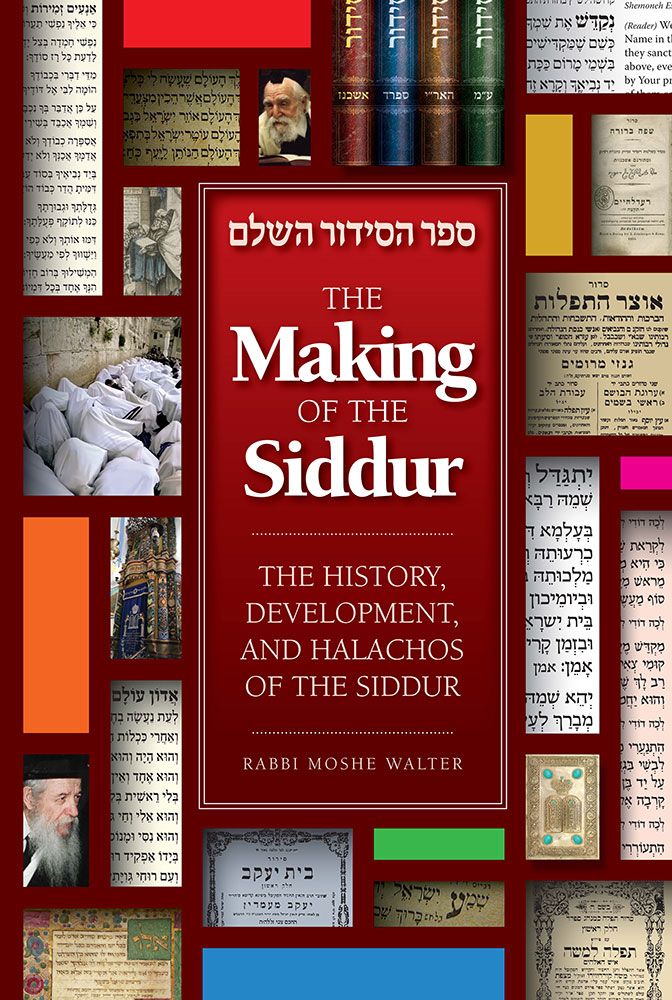
 The Making of the Siddur: The History, Development, and Halachos of the Siddur
By Rabbi Moshe Walter
Feldheim Publishers
New York, 2025
313 pages
We often take for granted the content of the siddur, the repository of our personal and communal prayers, because we grew up using it. We don’t realize that it is the result of thousands of years of evolution. Understanding the journey our prayers took gives us insight into what we say and why we say it. However, the story of the siddur easily becomes a complex and boring tale that alienates lay readers. Rabbi Moshe Walter, in his The Making of the Siddur: The History, Development, and Halachos of the Siddur, makes the history accessible with a number of delightful literary tactics.
One way Rabbi Walter, rav of Woodside Synagogue Ahavas Torah in Silver Spring, Maryland, and the executive director of the Rabbinical Council of Greater Washington, keeps the textual history lively is by focusing on controversy, which always captures the reader’s attention. The second and third chapters of the book are titled “Nusach Sefarad” and “Nusach HaGra.” Rabbi Walter not only tempts the reader who is naturally curious about these different prayer versions popular among Chassidim and their detractors, but he delivers with a faithful discussion of their origins and a lively description of their controversies. For Nusach Sefarad, the debate between the Chatam Sofer and the Divrei Chaim, and their students, was over the propriety of an Ashkenazi praying in this relatively new prayer text. For Nusach HaGra, it is the long challenge and debate over what exactly the Vilna Gaon’s siddur contained. Particularly since most people are used to praying the way they were taught, the examples of differences are fascinating and help everyone think more about their own prayers.
The bulk of the book focuses on specific prayer sections of weekday, Shabbat and yom tov services, explaining their origins and purpose. There is a progression in the prayer service, an overall structure designed to guide the individual and community through a process of praise and prayer. Rabbi Walter shows the reader the concepts underlying the prayers with sweeping reviews of the sources and varying customs, along with “takeaways” that simplify and summarize each chapter.
While the text remains accessible to the layperson, the scholar will find valuable sources and references. The Making of the Siddur serves as an introduction to the prayers while also contributing to the scholarly literature on the subject. Thanks to the author’s accessible style, the book can be used equally for light reading in small sections on Shabbat afternoon or as a textbook for a class on prayer.
 Stories & Halachah from the Psychiatrist’s Couch
By Dr. Yaakov Freedman and Rabbi Akiva Dershowitz
Adir Press
New York, 2025
190 pages
I find myself wondering why Dr. Yaakov Freedman’s stories of psychotherapy are so compelling. He is an accomplished storyteller but hardly the only one. And yet, I read his accounts with greater interest than other such books. Perhaps there is an element of voyeurism, seeing a brief glimpse of other people’s private struggles. Perhaps there is also a quiet sense of relief when encountering challenges I do not personally face. Given the wide range of cases and treatments described, nearly every reader will recognize both unfamiliar problems and familiar emotions.
More importantly, however, Dr. Freedman, a board-certified psychiatrist practicing medicine who maintains a private practice in Jerusalem, portrays the frum community as it actually is: a community of sincere, striving people living complicated lives. Idealized visions of perfect families and perfect communities do not exist. Yet that realism does not diminish the beauty of Torah life. On the contrary, it reinforces a crucial truth: The Torah is not meant to eliminate all human struggle. It provides a framework to live meaningful lives dedicated to Hashem, even as we go about our mundane activities and struggle with our human frailties. The Torah refines us; it does not render us flawless.
In Stories & Halachah from the Psychiatrist’s Couch, Dr. Freedman presents thirty case studies drawn from his psychiatric practice, not all of which conclude with neat or happy endings. Some patients grapple primarily with chemical or neurological conditions, while others confront emotional or psychological turmoil. Across these varied stories, a consistent theme emerges: the courage required simply to seek help, followed by the sustained effort demanded by treatment itself. Improvement, when it comes, is rarely quick or easy. Dr. Freedman depicts patients who struggle honestly and persist with dignity, often over long periods of time.
The Torah is not meant to eliminate all human struggle. . . . The Torah refines us; it does not render us flawless.
The reader would be mistaken to conclude that Dr. Freedman is the hero in these stories. While he diagnoses, prescribes and guides the patients, the real labor belongs to the patient who wants to live a better life. A recurring element in that effort is faith, not as a substitute for professional care, but as a source of motivation and resilience. Dr. Freedman recognizes the centrality of faith and knows how to respect it, support it and integrate it into treatment as appropriate.
This is where the unique structure of the book proves especially effective. Each chapter concludes with a brief halachic reflection by Rabbi Akiva Dershowitz. At first glance, the combination of psychiatric case studies and halachic analysis might seem incongruous. In practice, it underscores the book’s deeper message. The halachic discussions highlight that faith sustains both patient and practitioner through the inevitable setbacks and uncertainties. In that sense, every reader is Dr. Freedman’s patient who can benefit from his faith-affirming practice.
 Va’Achabda Shimcha: Gilyonot Ve’Alonim B’Halachah
By Rabbi Moshe Shimon Bineth
2024
316 pages
One of the unusual features of the Orthodox Jewish community is the continued proliferation of paper publications in this increasingly digital world. Because Shabbat remains digital-free, Orthodox Jews still consume books, magazines and weekly newsletters even while the broader world moves away from print. Among the benefits of this religious phenomenon is the preservation, at least one day a week, of the classical culture of reading rather than the contemporary replacement of viewing and swiping. But print culture also brings its own challenges.
Already in the sixteenth century, about a century after Gutenberg popularized his printing press, halachic authorities struggled with the challenge of an overabundance of sacred writings. How do we respectfully dispose of these books so that they do not overrun our homes? In Va’Achabda Shimcha: Gilyonot Ve’Alonim B’Halachah (“And I Will Honor Your Name”: Sheets and Pamphlets in Halachah), Rabbi Moshe Shimon Bineth offers a survey of the four approaches that have been proposed over the ages for disposing of sacred writings: burning, respectful placement in the garbage, burial and recycling.
This full-length halachic work focuses primarily on Torah newsletters, addressing with impressive thoroughness the many questions they raise. May they include advertisements? May they be placed atop sacred books? Does a newspaper with a minority of Torah content retain any sanctity? Following the now-familiar model of halachic compendia, Rabbi Bineth presents clear rulings in the main text while using extensive footnotes to survey earlier authorities and apply their views to modern cases. Because the subject is so narrowly defined, the book explores virtually every conceivable angle, including unusual scenarios such as whether a litigant in a beit din may swear an oath on a Torah newsletter rather than on a traditional sacred text.
The creativity of the book’s organization and the care with which its halachic insights are developed are evident throughout. Yet, what may be most striking is not any single ruling but the very existence of a halachic monograph devoted to Torah newsletters. As much as this volume contributes to halachic literature, it also documents a significant aspect of Orthodox Jewish culture in the first half of the twenty-first century: a community so committed to Torah handouts that it must now confront its own abundance.
Rabbi Gil Student serves as OU director of Jewish Media, Publications and Editorial Communications.