

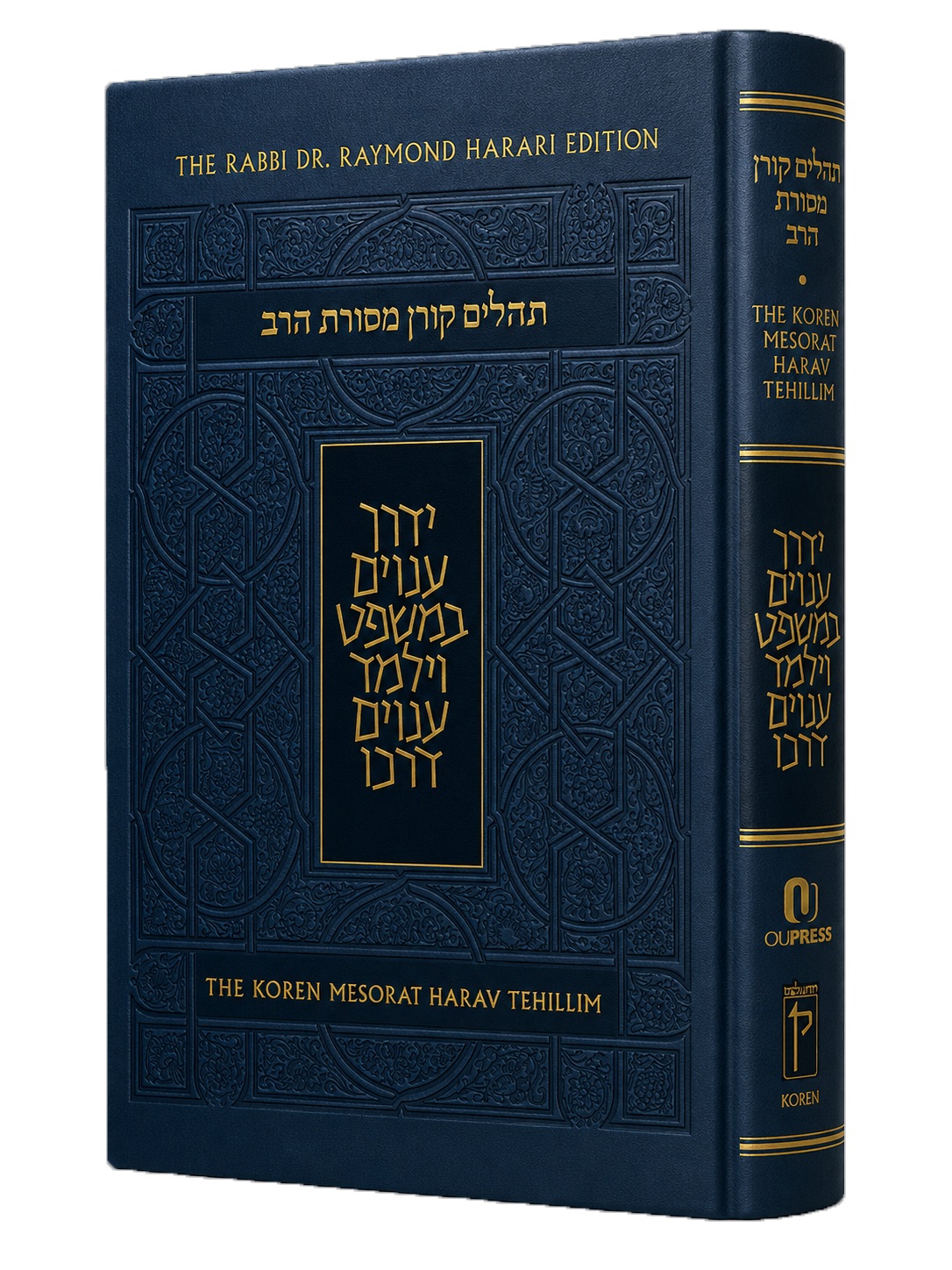
 The Koren Mesorat HaRav Tehillim, the Rabbi Dr. Raymond Harari Edition
With commentary based on the teachings of Rabbi Joseph B. Soloveitchik, compiled and edited by Dr. Reuven Mohl
OU Press and Koren Publishers, Jerusalem
Sefer Tehillim, the Book of Psalms, occupies an unparalleled position in the Jewish library. For millennia, it has served as the collective beating heart of the Jewish people—the repository of our deepest fears, our grandest hopes and our most intimate conversations with the Almighty. In times of national crisis or personal joy, it is to the poetry of King David that we instinctively turn. Now, readers have a profoundly enriching new lens through which to experience these timeless words with the publication of The Koren Mesorat HaRav Tehillim.
To those who view Rabbi Joseph B. Soloveitchik (the Rav) primarily as the consummate Brisker Talmudist—the master of rigorous, analytical Halachah—a commentary on Tehillim might initially seem like an unexpected venue for his thought. However, as Rabbi Menachem Genack notes in the volume’s preface, the Rav was also a man of immense depth of religious feeling, an exemplar of the ne’im zemirot Yisrael (the “sweet singer of Israel”). The Rav’s philosophical worldview, which so brilliantly embraced the dialectical tensions of human existence, finds its perfect Biblical counterpart in the Book of Psalms. The Rav’s homo religious is mirrored in the emotional turbulence of King David.
The editorial achievement of this volume lies in the masterful work of compiler and editor Dr. Reuven Mohl who has seamlessly stitched together a commentary from across the Rav’s vast corpus—including Halakhic Man, The Lonely Man of Faith, Worship of the Heart, Out of the Whirlwind, The Emergence of Ethical Man and numerous other published essays and lectures. The commentary breathes life into verses we have recited by rote for years.
To understand the Rav’s approach to the very act of reciting Psalms, one need only look at his remarkable exposition on Psalm 131 (“Lord, my heart is not proud . . . like a weaned child is my soul within me”). Contrasting the intellectual assertiveness required for Talmud study with the emotional surrender necessary for prayer, the Rav notes:
Prayer is an art, not just a mechanical performance. It is an attitude, a state of mind, a mood. It is a great and exciting experience, an adventure . . . . The adult, the proud mind, the independent thinker, the genius—none of them are admitted to the heikhal ha’tefillah, the palace of prayer. They do not know the art of prayer. Talmud Torah requires self-affirmation and self-appreciation, confidence in one’s ability to understand and judge, to discriminate and equate. Tefillah demands self-negation, just the opposite approach. The mood that generates a desire for prayer is one of hopelessness and bankruptcy. To pray means to surrender one’s pride and self-confidence, to put aside any awareness of greatness, freedom, and independence. Prayer is for those who are simple, who are capable of complete surrender and of complete trust in the Holy One, whose “heart is not proud,” whose soul is like that of “a weaned child.” (p. 505)
This contrast between the self-assured scholar and the dependent, vulnerable supplicant captures the essence of what it means to open a Sefer Tehillim.
The physical presentation of the volume beautifully complements the majesty of its intellectual content. Set in the classic Koren Tanakh typeface alongside the masterful English translation by Rabbi Eli Cashdan, z”l, the layout is designed for both rigorous study and daily prayer. The volume is thoughtfully appended with a comprehensive bibliography and an index mapping the Rav’s works to specific Psalms, allowing scholars to easily trace the original context of the commentary.
This edition is dedicated as the Rabbi Dr. Raymond Harari Edition, honoring the memory of a lifelong student of the Rav. As the touching dedication notes, Rabbi Dr. Harari lived comfortably with the dialectical worldview taught by his rebbi, embodying both Adam I (the purposeful builder of institutions) and Adam II (the inward seeker of the covenant).
For the contemporary Jew, reading Tehillim can sometimes devolve into a rapid, mechanical recitation of ancient words. The Koren Mesorat HaRav Tehillim rescues us from the peril of overfamiliarity. It challenges us to pause, to think and to feel the existential weight of King David’s poetry. Whether one is crying out in a moment of personal distress, seeking comfort in the “shadow of His wings,” or singing joyous praises for national redemption, the Rav’s profound theological insights serve as the perfect guide.
This volume is an indispensable addition to the modern Jewish library. It succeeds not only in preserving the legacy of one of the twentieth century’s greatest Jewish thinkers but also in elevating the recitation of Psalms into a deeply transformative encounter with the Master of the Universe.