
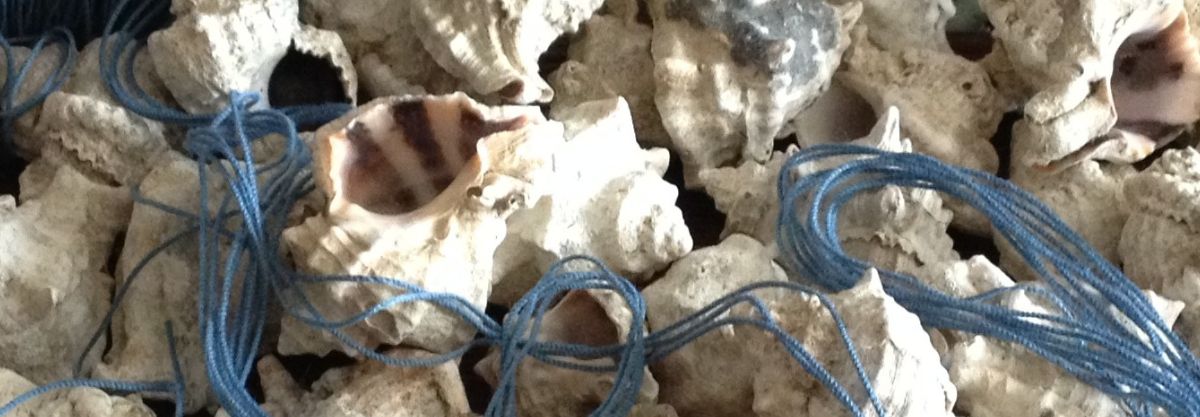
The Hexaplex trunculus, a predatory sea snail native to the Mediterranean Sea, is believed to be the long-lost chilazon. Courtesy of the Ptil Tekhelet Association
The tradition identifying the chilazon and the process of extracting its dye had been lost to the Jewish people. So how was this long-dormant mitzvah revived?
For more than a thousand years, the Torah’s most visually striking commandment was also one of its most elusive. The mitzvah—“that a thread of blue be placed among the fringes (tzitzit) worn on the corners of a four-cornered garment”—remained intact in practice yet incomplete. Jews continued to wear tzitzit, but without the blue thread, preserving only the white strands. The mitzvah was not forgotten, but it became dormant, awaiting rediscovery.
Why blue? The blue thread, the petil techelet, serves as a reminder of higher truths: the sea, the sky and ultimately the Divine Throne. Beyond symbolism, however, it is a concrete halachic requirement: When techelet is available, one is obligated to include it in their tzitzit.
From the time it was commanded at Sinai, this mitzvah was widely practiced. Fabrics dyed with traces of blue were found in the caves of Qumran. The blue dye was produced from a marine creature known as the chilazon, whose identity and exact processing method were transmitted through tradition. However, around 1,300 years ago—likely during the upheavals of late antiquity and the early medieval period—the knowledge of the chilazon and the production of techelet were lost.
A Bold Attempt to Discover Techelet
In the nineteenth century, a bold attempt was made to revive this lost commandment. The Radziner Rebbe, Rabbi Gershon Henoch Leiner, a brilliant scholar from the Izhbitzer chassidut, based in Lublin, Poland, undertook extensive research into the identity of the chilazon. Drawing on Talmudic sources and scientific inquiry, he concluded that the source was a type of cuttlefish. In the 1880s, he traveled from Poland to Italy to search the Bay of Naples in the Mediterranean Sea. With great difficulty, he succeeded in producing a blue dye and began distributing techelet to his followers. Despite his passion and scholarship, his identification of the chilazon was not widely accepted. Most rabbinic authorities questioned both the species he identified and the chemical process used to create the dye, and the broader Jewish world did not adopt his techelet.
But the quest and research did not end there. In the early twentieth century, Rabbi Isaac Herzog—later the first chief rabbi of Israel—devoted his doctoral thesis to the subject of techelet. His genius encompassed science, chemistry, history, secular scholarship and the breadth of Jewish literature. With rigorous academic methodology, he evaluated the Radziner’s claims and proposed an alternative candidate: His research indicated the Hexaplex trunculus snail, a predatory sea snail native to the Mediterranean Sea that seemed to fit the descriptions of Chazal and was used in antiquity. Although he himself had some doubt, due to misinformation he received on the permanence of the dye, his work laid the intellectual and scientific groundwork for future efforts.
The Quest Continues
In the late 1980s, Rabbi Eliyahu Tavger, the current rabbinical advisor of Ptil Tekhelet, took up the challenge. Motivated to fulfill the mitzvah in practice, he began researching the Hexaplex trunculus in depth. He was soon joined by others who shared both his curiosity and determination, including Joel Guberman, a co-founder and director of Ptil Tekhelet who is a pediatric occupational therapist, Baruch Sterman, a co-founder of Ptil Tekhelet who holds a doctorate in physics from the Hebrew University and a master’s in electrical engineering from Columbia University, and me.
At Rabbi Tavger’s behest, we went searching for the snails. Together, we dove into the Mediterranean Sea to collect the snails believed to be the long-lost chilazon. Through experimentation with other experts, we recreated the ancient dyeing process, including the crucial role of sunlight in producing the distinctive sky-blue color. With these breakthroughs, the possibility of renewing techelet became tangible. Out of these efforts emerged the nonprofit organization Ptil Tekhelet, dedicated to producing and distributing kosher techelet strings in accordance with halachic standards.
The mitzvah was not forgotten—it became dormant, awaiting rediscovery.
Now that kosher techelet strings were being distributed, we needed to learn how to tie the techelet to our tzitzit. The Gemara describes chuliot, groups of windings on the strings, but different alternations of blue and white winding are understood from the Talmudic texts. In addition, different early rabbinic traditions of how many strings of techelet belong in each corner—one string, two, or half a string dyed blue—has resulted in many different permutations of how to tie the tzitzit.
Part of Ptil Tekhelet’s mission statement is to educate Jews about tzitzit and techelet. In the early years, the sum total of books on techelet could be counted on one hand. Today, there are hundreds of such articles and books. Despite opposition in the years after it was introduced, much of the Jewish world seems to be accepting the thread of blue, and it is stocked in most Judaica stores.
So today, after more than a millennium, techelet has returned to Jewish life. While debate continues in some circles regarding its identification, thousands have embraced the opportunity to fulfill the mitzvah as it was originally intended. The story of techelet is not only about a commandment, but about loss and rediscovery, tradition and investigation, and the enduring desire to reconnect with the fullness of Torah observance.
Dr. Ari Greenspan, a practicing dentist based in Jerusalem, is a co-founder of the Ptil Tekhelet Association. A mohel, shochet and sofer, he has worked for more than forty years collecting Jewish traditions and mesorot from far-flung Jewish communities in Africa and Asia, which he visits and supports.
In This Section
The Artistry of the Tallit by David Olivestone
Out of the Blue: Return of Techelet by Dr. Ari Greenspan