
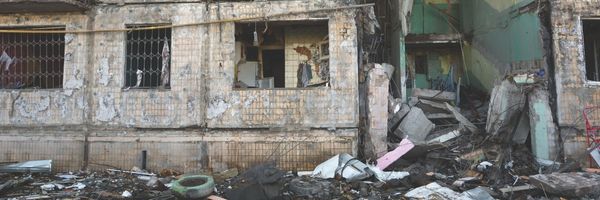
Russia’s ongoing war in Ukraine continues to leave widespread destruction. Photo: Synel/Alamy Stock Photo
It was Friday night at Kharkiv’s Beis Menachem, the only operating shul in Ukraine’s second-largest city. About a hundred people, mostly parents with children, had gathered to celebrate Shabbat. To break the ice, Miriam Moskovitz, the shul’s Australian-born Chabad rebbetzin, posed a question.
“What do you associate with the word kehillah?” she asked.
“Family,” everyone responded in unison.
For many of the roughly 150,000 Jews (according to various Jewish sources) remaining in the war-torn country, the Jewish community—and the shul—has become their closest kin. Each week, more new faces appear, signaling that Ukraine’s Jews are reconnecting with their roots. The pull to Judaism is not new. A teshuvah movement began in the 1990s with the fall of the former Soviet Union. Many of that first generation of ba’alei teshuvah left for Israel or the West, but some remained.

With food insecurity a major problem facing Ukraine’s Jewish refugees, kosher soup kitchens offer some relief. Courtesy of Judi Garrett
“We are dealing with the grandchildren of people we knew as teens,” says Rebbetzin Sarah Bald. A former Brooklynite, she and her husband, Rabbi Mordechai Shlomo Bald, the chief rabbi of Lviv, have spent thirty-three years serving as emissaries of the Karlin-Stolin Rebbe in the Western Ukrainian city of Lviv, formerly known as Lemberg. The present war has surprisingly accelerated this process.
Today, thousands of Ukrainians, some halachically Jewish and others Jewish according to the Israeli Law of Return, have affiliated with the Jewish community, most for the first time in their lives. “People who have never entered a synagogue come to us,” says Rebbetzin Moskovitz. Some come to learn about Judaism. Most lack even the most basic information. Judaism—and in fact all religions—were illegal from 1922 to 1991, when Ukraine was part of the Soviet Union.
Others come for lack of other options. In war-torn areas, gyms, restaurants, community centers and clubs are closed. In those areas, the shul often serves as the only social outlet. “They come seeking connection,” says Rebbetzin Moskovitz. “Suddenly, these Jews realize that no one else cares about them except the Jewish community,” notes Rabbi Daniel Gordon of Jewish Relief Network Ukraine (JRNU), a Chabad humanitarian organization providing aid to Jewish communities in Ukraine.

For Jewish refugees throughout Ukraine, the shul is the place to go for help. Seen here, Ukrainian Jewish refugees sleep on mattresses in a shul at the Ukraine-Moldova border. Photo: Sipa USA/Alamy Live News
Many are internal refugees who have abandoned conflict zones for other supposedly safer parts of Ukraine. They have moved from Eastern Ukraine to central or western regions. “Some communities have even tripled in size because of this internal migration,” says JRNU’s COO Judi Garrett. Rebbetzin Bald says that her community, located in the relatively safer Western Ukraine on the Polish border, has doubled in size, increasing from 1,000 to 2,000 members since the war began. “Some come from here, from Kherson, others from Kyiv, Odesa, Zaporizhzhia, or Dnipro. Many stay in Lviv,” she says. “Others go on to Hungary, England, Israel or the US.”
Some people have lost their homes. “In East Ukraine, Donetsk and Mariupol, the Jewish communities no longer exist,” says Rabbi Gordon. Rebbetzin Moskovitz estimates that Kharkiv’s Jewish community of 10,000 is now roughly half its prewar size. Internal migration isn’t just a Jewish phenomenon. A UN study estimates that as many as 3.7 million Ukrainians have relocated within the country. Jewish internal migrants have an advantage—the shul is the place to go for help.
Suddenly, these Jews realize that no one else cares about them except the Jewish community.
“Previously, these people had never entered a synagogue. Now they are here looking for food, medicine they can’t afford, or assistance with burying a relative,” says Rebbetzin Moskovitz. The shul distributes 1,000 packages of basic foodstuffs, such as oil, eggs and canned goods, every month.
JRNU has distributed 400,000 pairs of glasses, as well as thousands of reflector bands for people to wear around their wrists or waists when they go out at night. “Because of martial law, which imposes curfews and frequent power cuts, it’s pitch black outside at night. The reflector bands help pedestrians remain visible to drivers,” Rebbetzin Moskovitz explains. But it’s not just about material aid.
“The shuls help these people fill an emotional and spiritual need for connection,” says Garrett. She points to high attendance at shul events like Sukkot meals or Chanukah candle lighting.
“Our community has become very close-knit,” says Rebbetzin Moskovitz. Just before this past Rosh Hashanah, the community celebrated Shabbat together in a forest two hours outside of Kharkiv. One of the highlights was the communal recitation of Selichot. “For the past three years, because of the 11:00 PM curfew, we could never say Selichot on time, but in this space we were able to,” says the rebbetzin. “We blew the shofar. We prayed for peace here and in Israel. There were programs for adults and for the children, and a lot of bonding.”
Some community members were inspired to lean into their Judaism in the most tangible way. Rebbetzin Moskovitz recently posted a video showing a group of middle-aged men celebrating the occasion of their circumcisions. And it’s not only adults. Garrett also points to a half-dozen teens who voluntarily underwent circumcision at their Chabad-sponsored religious summer camp.
Still, always in the background is the constant rumble of war. “We can have alarms all day long. It’s like Sderot,” says Rebbetzin Moskovitz, comparing Kharkiv to the Southern Israeli city that endured two long decades of missile attacks. The shul has had its windows blown out due to attacks. But it has its own generators to continue operating during the frequent power outages. In 2023, due to the Russian attacks on power stations and other critical infrastructure, the OU helped purchase and distribute thirty-five high-powered generators, each costing up to $50,000, to community centers and shuls in twenty cities around the country. But the bombing continues.
“Everyday life means going in and out of bomb shelters,” says Garrett. For kids, that means attending school underground. “Kids may spend the entire day in basement classrooms,” she says. JRNU has raised money to retrofit these underground classrooms. Even so, the psychological toll is severe. “There is constant fear. Where is my family? Where did they go when the sirens went off? How will I get to a safe space?” says Garrett.

Jewish Relief Network Ukraine (JRNU), a Chabad humanitarian organization, provides aid to Jewish communities in Ukraine. Courtesy of Judi Garrett
“Ninety-nine percent of these attacks occur in the middle of the night. That means we don’t have day or night,” says Rebbetzin Bald. And the situation is getting worse.
Over the past few months, the Russians have stepped up their attacks, sending waves of Iranian-manufactured, self-destructing attack drones that fly below the radar and most often at night. The deadly drones are notoriously hard to intercept. While a New York Times report quoted Ukrainian sources that claimed to intercept 88 percent of those attacks, that may not be the complete truth.
“The Ukrainians downplay the numbers to avoid causing panic, and they don’t want to let the Russians know how successful they were,” says Rebbetzin Bald. A New York Times report estimated that 80 percent of the war’s casualties have been the result of drone attacks.
Previously, these people had never entered a synagogue. Now they are here looking for food [and] medicine they can’t afford . . .
When missiles or drones hit the city, people run to safety in underground parking lots, subway stations, basements and stairwells. Unlike Israel, purpose-built shelters and safe rooms in apartments or buildings do not exist in Ukraine. It’s hard. “In the freezing cold and boiling summer, thousands squeeze into one underground car park,” says Rebbetzin Bald.
For as many as half of all Ukrainians, there is no safe place to go. “Some people spend entire nights walking the streets, figuring they are safer outdoors than in a building that could collapse on them,” says Rebbetzin Bald. In addition to causing injury and death, the drones and missiles have wrecked apartment buildings, energy infrastructure buildings and even aid distribution sites. Working throughout Ukraine, JRNU has helped thousands of Ukrainian Jews to either repair their damaged homes or find other places to live.
With prices shooting up and salaries remaining at low prewar levels, another major problem is food insecurity. “At the moment, the biggest challenge is poverty,” says Rabbi Gordon. “People are losing hope. They are finding it difficult to support themselves, and they are not seeing an end to this,” he says.
Ukraine has always been a poor country, he notes, but because of the war, many people are living in situations beyond what most people in the West could imagine. Rabbi Gordon describes his visit to Jewish orphans in Zhytomyr in Western Ukraine. “It was snowing, the house had no heat—just a tiny oven to cook on and an outhouse.” People living in the cities are faring a bit better. “There is food in the shops,” says Rebbetzin Bald, “but you need money to buy it. Money is scarce.”
“Businesses have broken apart, and people are not investing in Ukraine. We see former business people without money, food or jobs,” she says. They often turn up at her husband’s shul asking for help.

Some Jewish refugees from Ukraine fled from nearby Moldova to Germany. Photo: Frank Schultze/Alamy Stock Photo
Though their stories are wrenching, fundraising for Ukraine’s Jewish community is not easy. Potential donors are tired of this war. Since October 7, many have shifted their giving to Israel. This is because they don’t understand the situation. “They [potential donors] say the Jews should leave just like they left Nazi Germany,” says Garrett.
So why don’t they? Why doesn’t the community just make aliyah? Some have tried. When the war broke out in 2022, thousands left. However, many of them have returned. “As wonderful as Israel is, it’s a different language and culture,” says Garrett. And many of these Jews identify as Ukrainians. “A lot of people feel a deep connection to the country,” she explains.
President Zelensky is popular among Ukrainian Jews. “He has come to visit our schools and has been very supportive of the Jewish community,” says Garrett. Though he himself is intermarried and unaffiliated, Zelensky’s parents are part of the Jewish community in their hometown of Kryvyi Rih in Central Ukraine. Some people do not leave because they refuse to abandon elderly parents who cannot travel. Others have husbands or sons who are in the army. Some have both. Some people are intensely patriotic. Others are terrified.
The draft is a very sticky issue. According to Ukrainian law, all men aged eighteen to sixty-two with fewer than three children must serve in the military. Enforcement is strict. Not only are men of draft age barred from leaving the country, but they can also be pulled off the street and forcibly drafted. “Some men hide at home or change residences to avoid being called up,” says Rebbetzin Bald. She tells of one of her congregants who was snatched into the army as he was leaving davening. “He was beaten up, his teeth were knocked out, and he was taken.”
Maybe this is why the war broke out—to return us and our children to our roots.
The war has negatively impacted family life. “In many homes the father is gone,” says Garrett. That leaves mothers alone to raise the children, work, and, in many cases, care for elderly parents or in-laws. Army service is dangerous—hundreds of thousands have been killed since the war began.
PTSD is rampant. And the war’s extreme demands have strained the army’s ability to attend to soldiers’ needs for health care or battle rations. “Once you are in, you are in,” says Garrett. “It’s not like they are sending people home while the war is on; it’s a huge problem.” As hard as it is, army service is part of life, and the Jewish communities extend their support to Jews who are part of the Ukrainian military. “In shul, we say a prayer for all Jewish soldiers who are fighting. We sent arba minim, food and siddurim to keep them encouraged, and we keep in touch with them,” says Rebbetzin Moskovitz.
Rebbetzin Bald recalls the soldier who showed up to her Pesach Seder. “He got off, and he took those few precious moments to join our second-night Seder. We were in awe of this guy, who, after months in the army, comes home to see his only child for a few hours, yet it was important to him to participate in a Seder, eat matzah and drink grape juice—his Yiddishe neshamah bright as ever.”
Rebbetzin Bald isn’t surprised. After more than three decades of living with them, she believes Ukrainian Jews possess an inner strength. “They are not so fragile, because they went through a lot even before this war. Culturally, they have the stamina. I learn so much from them.” Rabbi Mendel Gottlieb, the Chabad shaliach in Lviv, demonstrates this with the story of twenty-three-year-old Yura Urshansky, a new ba’al teshuvah who joined the army willingly.
Several months into his service, Yura’s father passed away. “Yura wanted to know what he could do for his father,” recalls Rabbi Gottlieb. “‘Say Kaddish,’ I told him.” Even under the rigorous conditions of army service, Yura tried his best. Tragically, four days after their conversation, Yura was killed. “Now our congregation recites Kaddish for both Yura and his father,” says the rabbi.
These days, Ukraine has many Jews like Yura. “People are searching for meaning and hope,” says Rabbi Gottlieb. He quotes another one of his congregants, Olena Yurchin, a mother of two whose Jewish identity was awakened as a result of the war. “Maybe this is why the war broke out,” she said. “To return us and our children to our roots.”
Carol Ungar is an award-winning writer whose essays have appeared in Tablet, the Jerusalem Post, Ami Magazine, Jewish Action and other publications. She teaches memoir writing and is the author of several children’s books.
In This Section
Under Fire They Came Home: How War Is Drawing Ukraine’s Jews Back to Jewish Life by Carol Ungar
A Legacy Rekindled in Kharkiv: An OU Kiruv Initiative That Impacted Generations by Carol Ungar
The Bread of Affliction That Also Brings Hope by Carol Ungar