

Jewish Action presented Jewish jokesters Eli Lebowicz and the Goldgrab brothers behind The Frum Side comics with thought-provoking questions about their work. The following is a panel discussion–style exclusive on the Jewish perspective on comedy.
Jewish Action: Is there a real difference between laughing with a community and laughing at it? How do you personally determine on which side of that line your work falls?
Eli Lebowicz: If you’re part of a certain community, you have the ability to say something with more credibility and validity than when you’re out of it. When I’m doing a comedy show for an Orthodox shul, being an Orthodox Jew helps with that authenticity, since I’ve experienced what they have. But if I’m doing shows for communities of other denominations, I’m more hesitant to make a joke about them, since I don’t know if they’ll be okay being teased a bit by someone coming from an Orthodox perspective.
There are a lot of people who rip on Judaism with a general cliché approach of, “Judaism and religion is the worst, right?” And you see it’s coming from a bad experience or cynicism. My approach is more, “Judaism is really weird and funny. I practice Judaism, so I can certainly tell you it’s got its quirks.” There’s much more trustworthiness and reliability when you’re coming from a good place rather than a negative, cynical place.
Levi Goldgrab: When someone laughs at a community, it’s usually from standing outside of it. Even if it’s someone inside the community, it can come from a derisive place, a place of cynicism and scorn. It comes from a negative feeling, and it’s being expressed in that way.
Laughing with a community is different. It comes from standing within the community, feeling part of it, consciously wanting to be part of it. Being able to poke fun at and make light of certain things within your own community shows that you identify with it and are part of it.
It’s like how brothers or family members joke with each other. They might poke fun at themselves or at things they do. It’s not because they’re trying to scorn it. It’s because they’re part of it. It’s a way of processing, navigating, and being part of the community.
Mendel Goldgrab: I believe there’s space within the community, and each person individually, for both types of laughing. We’d fall into both camps, laughing with and laughing at, but I mean laughing at in a good-hearted nature only.
JA: Comedy often invites exaggeration and negativity. Are there specific “red lines” you’ve set for yourselves—topics, tones or angles that you simply won’t touch, even if they might guarantee a laugh?
EL: I’ve kind of established being a clean Jewish comedian. I don’t curse on stage, and topics that are more risqué aren’t my brand. For example, there are times when I’ll think, “Oh, that’s a great joke, but it’s not something that I could do onstage.” I’m not necessarily trying to be squeaky clean, but I’m going for what the audience will respond to positively. If I put a lineup together of comedians for a shul, I’ll emphasize to be clean, not just because they want that, but the comedians won’t do well if they’re not, and ultimately that’s what the goal is.
Everyone has different limits with topics they think are off-limits. I think there are topics that you can make fun of, like antisemites, but there are topics that are trickier to make fun of, like those who have experienced antisemitism. But if you can lampoon all the hateful Internet commenters, making fun of their antisemitic viewpoint, you’ve kind of empowered people to stand up to the bullies.
LG: Humor is really a tickle to the brain. It’s a surprise, something the brain doesn’t expect. That’s where absurdity comes in, and sometimes even a bit of edginess.
But there are red lines we won’t cross. We won’t make fun of an individual as a person. We might use a well-known public personality as part of a joke because they’re already in the public space, but we won’t make fun of someone personally. We also won’t make fun of holy people, tzaddikim or big rabbanim. And we won’t make jokes that are vulgar, immodest, or that go against Torah values.
MG: There have been funny ideas we’ve had that we ended up passing on, mostly due to not wanting that person/group to feel bad or othered. Plus, we specifically stay away from politics and current events.
JA: Chazal famously speak about comedians who earned Olam Haba because they lifted people’s spirits. Do you see a specific spiritual value in the work you’re doing? If so, where does that manifest most clearly?
EL: Yeah, that gemara in Taanit talking about jesters going to heaven is definitely what I’m intending to bring with me on judgment day when I go up to heaven and have to face the music.
Especially with how heavy the last few years have been, you see value in being able to lift people’s spirits. If you can find a way to make somebody laugh for an hour when they haven’t in a long time, that’s admirable. It’s nice when people say to me, “You know, I haven’t really laughed since the war started.”
I do J-Sketch together with Ami Kozak and Mikey Greenblatt, and when the war started, we didn’t know what to do. So, one of the sketches we did was about sending supplies to Israel, like all the shuls and sisterhoods that were sending supplies in mass, and we kind of made light of all the ridiculous things that people in America were sending to Israel to try to help out. It’s not making fun of the terror attack but rather making fun of our response of “we’re trying to help, but we don’t know how to help” because there’s humor in that. People told me, “This is exactly the laugh I needed.” If you can make people laugh about painful things, that’s really helpful.
LG: There is definitely spiritual value in what we’re doing. A big part of it is simply lifting people’s spirits. We started this because we have a good time with it. We genuinely enjoy it. That’s really the main thing. And we’re lucky that in the process, other people as well are having a good time.The Gemara says that the Amora Rabbah would begin his shiur with a “milsa d’bedichusa—a humorous remark,” “ubadchi rabbanan—and the Rabbis laughed” (Shabbat 30b). Rashi explains, “niftach libam machmas hasimchah—Their hearts were opened through the joy.” When a person is in a good state of mind, they are more receptive. I really believe that everything good comes from a good state of mind. A person can’t express their spirituality properly, can’t learn Torah properly, can’t do mitzvos properly, if they’re in a bad state of mind. A bad state of mind doesn’t lead to good things. A good state of mind—a calm mind, a peaceful mind—becomes an expansive mind. Humor is one of the tools that brings a person there. And once that openness is there, it opens the door to a lot of beauty in life, and in Torah and mitzvos as well.
At the same time, I think humor can be a real tool for the community. I think it’s important for a community to self-assess, to do introspection, to ask: What are we doing right? What can we do better? Are there areas we’re not talking about that maybe should be talked about so people can benefit? One way of doing that is through humor. People get defensive when they’re challenged about shortcomings. We all put up defense mechanisms. Humor helps drop those defenses. It helps us take an honest look at ourselves as a community, as well as personally. When humor is used that way, it’s not cynical. It’s constructive. It helps better the community.
MG: For sure, the Frum Side comics are a spiritual mission. Rabbi Nachman says that one must do whatever they can to make themself happy, even doing silly things. Hashem blessed us with this opportunity to share humor with people who are starving for a kosher laugh. We have fans who print out the weekly comics to share by the Shabbos table. We have a fan who prints dozens of copies of the weekly comics to distribute in shul. We have mental health support groups that share our comics to help get through the day. I think Hashem blesses everyone with something specific that is for them to share with the world, to elevate people that need it. We are all shluchim innately, and I look at our comics as my shlichus.
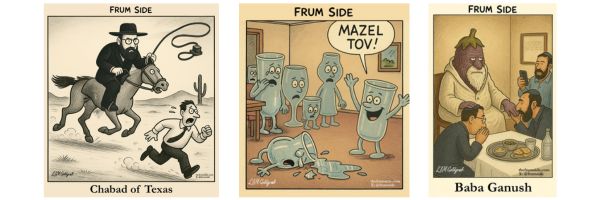
Courtesy of L&M Goldgrab, TheFrumSide.com
JA: How do you keep your work positive and avoid slipping into cynicism or cheap shots, especially when you’re drawing from communal frustrations that audiences instantly recognize?
EL: I try to make jokes about topics that are well-known and talked about across the board, such as the price of tuition or antisemitism or just general angst that people are dealing with. I don’t try to be cynical. I do it authentically. There is so much seriousness and negativity in the world. It’s an interesting perspective to ask, “Why is that weird? Why is that funny?”
Plus, you can really give mussar through comedy much better when it’s not just over-the-top. If you can find a clever joke as a subversive way to discuss stuff like the materialism of a shalom zachar or dating issues and being too superficial with shadchanim, I think that’s powerful. But you can’t do it with cynicism. You go for the joke, but you have to be a little bit more creative with how you get to it.
LG: There have been times when we realized that a joke we were about to make was coming more from frustration. That’s why it’s good that there are two of us. As brothers, we’re open and transparent and honest with each other. We can call each other out clearly and bluntly when we need to, and we’re receptive to that. We’ve stopped ourselves in the past.
When we remind ourselves that humor is a tool to open the mind and create a positive feeling, then there’s no desire to take cheap shots or slip into cynicism. A joke that has a negative feeling behind it might get a cheap laugh, but it doesn’t leave a good feeling. That’s not something we want to do.
We’re not perfect. We’re not malachim. We’re human. So it’s something we always have to keep an eye on.
MG: It’s not easy. Being cynical about the community is an easy laugh. And honestly it feels good at the time, but it’s never really good for anyone or worth it. I’m much more cynical than my brother. They say when you want to tell someone off, you should write it in a letter and put it in your drawer until the next day. My brother acts as the drawer in this relationship. Cynicism and cheap shots are low-hanging fruits, we try to aim a bit higher.
JA: On a lighter note, what is your favorite joke—one that you feel truly lifts people up and captures the best of the community?
EL: One of my favorite Jewish jokes comes from the comedian Myq Kaplan. He says, “Somebody came up to me and wished me a happy Easter, and I said, ‘Actually, I’m Jewish and we don’t believe in . . . happiness.’” Now, I know that’s not so positive about the Jewish community, but I think it is resonant because it touches on the fact that it’s difficult for Jews to be happy. There’s so much negativity in the world, so much hate, that it’s hard for us to focus on the good. It’s an interesting thing to joke about.
Another one of my favorites is the running joke about how Jews are obsessed with food. That’s just one of our things. We’re into food. Our number one concern is what the food situation is going to be at an event. I think we’re even more worried about food than antisemitism because we’re more worried about running out of food than running out of Jews. We know that people hate us and are trying to kill us. What we don’t know is whether there are more mini-hot dogs coming out at kiddush.
LG: It’s hard for me to choose one favorite joke. There are a few that make me laugh the most.
One is our “Mazel Tov!” comic. There’s a broken anthropomorphic glass cup on the floor, water spilled, and all around it are anthropomorphic drinking glasses and cups reacting in horror, like something terrible just happened. And one glass in the front is happily shouting “Mazel tov!” completely missing the cue. It’s that clash between seriousness and absurdity.
Another is the Baba Ganoush one: an anthropomorphized eggplant with wrinkled skin and a white beard giving a berachah and getting his hand kissed. The visual alone just makes me laugh. Sometimes it’s just the absurdity of the idea.
But probably one of my favorites is the Zemiros one. A typical frum family sits at the Shabbos table. The father’s eyes are closed, singing zemiros with intensity and deveikus. Meanwhile, a gigantic fly has grabbed one of the kids and flown out the window. Food is knocked over. The family members are in shock. The father, still eyes shut in his state of deveikus, is oblivious to what’s going on. But no one interrupts him, because “Zemiros were never to be interrupted.” It’s absurd, but it captures something familiar. We all grew up with moments where certain rules or rituals were so absolute that even in absurdity, they continued. It’s that contrast between his intense devotion and the total chaos happening around him.
MG: My favorite comic of ours is the Humpty Dumpty one with the Breslov guy. The Breslov guy hands a flyer to the cracked Humpty Dumpty that says “broken body, broken soul.” And the caption reads, “All the king’s horses and all the king’s men never had heard of Rebbe Nachman.” I think it’s funny and has a great message.
LG: At the end of the day, we started this because we have a good time with it. If we’re laughing and others are laughing, and people feel a little lighter afterward, then that’s the best outcome.