
The Artistry of the Tallit

At a planning meeting for the First Zionist Congress in Basel in 1897, the question of designing a flag for the nascent movement came up. One of the leaders, David Wolffsohn, asked, “Why do we have to search?” Holding up his tallit, he said, “Here is our national flag.” And so was born the flag of Israel, with the Magen David in the center and its two blue stripes on a white background that echo the stripes of the tallit.
The mass production of tallitot (common usage: talleisim) began with the Industrial Revolution, when major tallit factories were established in Lodz and Bialystok, Polish cities that were centers of the textile trade. The industry flourished in America, too, until the second half of the twentieth century, when Israeli imports began to dominate the market. Legendary brands such as Wolozin and Munkatch faded away, although ZionTalis, the best-known brand of that era, is still in business.
Recently, most production of Israeli tallitot has moved to India and China, such as at a company improbably called the Zhangjiagang Tallit Textile Co., Ltd. The only remaining large factory producing tallitot in Israel, which also has a chain of over forty retail stores, is Mishkan Hatchelet, founded by Shlomo Avrahami, an urbane entrepreneur who designs his products himself.
Tallitot are woven on looms, today computerized, in a continuous length of cloth, with the stripes positioned at the appropriate points. The fabric is then bleached and cut into lengths according to size. The loose threads where the cuts were made are tied by hand into the familiar decorative knots that run up and down the sides of each tallit. Holes are made in the corners for the tzitziyot to be inserted, and corner reinforcements, as well as the atarah (decorative strip around the collar), are sewn on.
The origin of the stripes and the pattern of their layout on the tallit is lost in history.
Most tallitot for Ashkenazim are woven with the familiar design of five bold black stripes, with the middle one being a little wider, sometimes very noticeably so. Some designs have slimmer white stripes interspersed among the black. Closer to the edge, another stripe of varying widths contains a cluster of thin or patterned stripes; there appears to be no end to the seemingly random variations the weavers can come up with.
Many Sephardim, as well as some kohanim, prefer a tallit with more subtle white stripes, and some men like to wear an all-white tallit on the Yamim Noraim. Various Chassidic groups have their own traditions for the pattern of the stripes, usually based on a design favored by one of the early rebbes.
The origin of the stripes and the pattern of their layout on the tallit is lost in history. Textiles found in the Qumran caves dating from the second century ce, and figures on the frescoes of the third-century Dura-Europos synagogue both suggest that Jews wore striped robes similar to those worn by Roman senators. In that era, a man’s outer garment was basically a large woolen rectangle with an opening for the head. Since it had four corners, Jewish men added tzitzit to it in accordance with the Biblical command.
That the stripes on the garment were originally blue was assuredly an allusion to the thread of the sky-blue techelet color in the tzitziyot. It was probably after the destruction of the Second Temple that the color of the stripes was changed to black, either so as not to be accused of replicating the priestly robes, which could no longer be worn, or possibly as an expression of mourning for the Temple.
Over the centuries, as clothing styles evolved, men began to wear shaped, buttoned coats, which gave rise to the practice of wearing a tallit katan as a four-cornered undershirt all day. In the main, a tallit katan is made without any embellishments, although there are some examples, no doubt produced as gifts for special occasions, that boast magnificent fabrics. In the eighteenth century, tallitot decorated with elaborate embroidery also became prestigious gifts and were even viewed as status symbols in the synagogue.1
For Sephardim, including those in some European countries such as Italy, Turkey, Germany and Holland, the tradition was to wear tallitot made of silk. Many Sephardim still follow this custom today and wear a silk tallit as a shawl, hooking it into their elbows.
Some specifically local tallit designs still survive. An Italian company, Talled di Seta, produces beautiful silk tallitot embroidered with ivory silk thread, and embellished with long knotted tassels. The traditional Yemenite tallit, called a shamla, is frequently made of black or colored wool. There are also many artisanal handweavers, both in Israel and other countries, who produce tallitot of extraordinary skill, following tradition or innovating new beauty of design.
Wrapping oneself in a tallit can evoke transcendent emotions as the wearer is enveloped in a “robe of light.”
The choice of a tallit is governed by each individual’s taste and understanding of hiddur mitzvah (aesthetically enhancing the mitzvah). As Shlomo Avrahami says, “The preferred fabric for a tallit is pure lamb’s wool, and we use that for the highest levels of kashrut. But today there are no limits to the designs or colors that we can use.”
In fact, many tallitot are now made of acrylics. Light and dark blues, greys, reds and yellows are just some of the colors that may be found in the stripes, which are configured in any pattern that the designer chooses, often with shiny metallic threads woven in. There are also popular options for more open weaves, which help prevent the tallit from slipping off the shoulders. But the principal opportunity for hiddur mitzvah is found in the atarah.2 The most common designs feature either an elegant white-on-white pattern of leaves and flowers, or the words of the berachah that is said before putting on the tallit. Many men replace it with a more decorative atarah. This may consist of several linked rows of stamped silver or gold squares, metallic threads in bold swirls, or needlepoint designs personalized for the user with a favorite pasuk or ornamental motif. Matching designs may also be applied to the four corner patches.
“Spanier Arbet” is the term used to describe a particularly elaborate form of metallic ornamentation on the atarah and on the corners of the tallit that originated in Eastern Galicia in the first half of the nineteenth century and was highly prized. This technique involved braiding thick and heavy metallic cords that were artfully coiled into floral motifs. Though created through a much simpler production process today, this type of shimmering silver adornment remains popular in the Chassidic community.
Wrapping oneself in a tallit can evoke transcendent emotions, as the wearer is enveloped, as it were, in a “robe of light.”3 It is, as former British Chief Rabbi Joseph H. Hertz wrote, “an outward expression of an inner thought,” inspiring and uplifting its wearers. The abounding creativity and care devoted to the design of the tallit is deeply woven into the fabric of Jewish life and has been a defining expression of hiddur mitzvah throughout the long arc of Jewish history.
The Tallit on the Yamim Tovim
The tallit plays a special role on Rosh Hashanah, Yom Kippur and Sukkot, as well as on the other major festivals, when Birkat Kohanim (the blessing by the priests) is said in shuls all around the world. Because of the tradition to avoid looking at the kohanim, since in Temple times the Shechinah rested on their fingertips, the custom is to cover one’s head and face with the tallit. The custom is also to gather one’s children and grandchildren under the tallit, creating warm family memories that last a lifetime.

Silk and needle lace tallit, made in Italy in the late eighteenth or early nineteenth century, embellished with delicately stitched floral designs in ivory silk
Photo © The Museum of Fine Arts, Houston; by Ramon Perez

Tallitot are woven on looms in a continuous length of fabric. Courtesy of Mishkan Hatchelet

Vintage ad for ZionTalis Manufacturing Co., Inc.
Courtesy of ZionTalis third-generation owner, Steven Yaroslawitz

Chabad tallitot feature a distinctive pattern of heavy black stripes. Courtesy of Mishkan Hatchelet

Tallitot may be woven with stripes in many different colors and patterns. Courtesy of Mishkan Hatchelet

Dutch mid-eighteenth-century silk tallit, its corners adorned with ornate metallic-thread brocade and floral embroidery
Photo © Museum of Fine Arts, Boston, Jetskalina H. Phillips Fund

A sumptuous eighteenth-century silk damask tallit from Germany, with polychrome-patterned brocaded silk appliqué and gilt metal-thread braid on the back and corners
Courtesy of Sotheby’s, New York
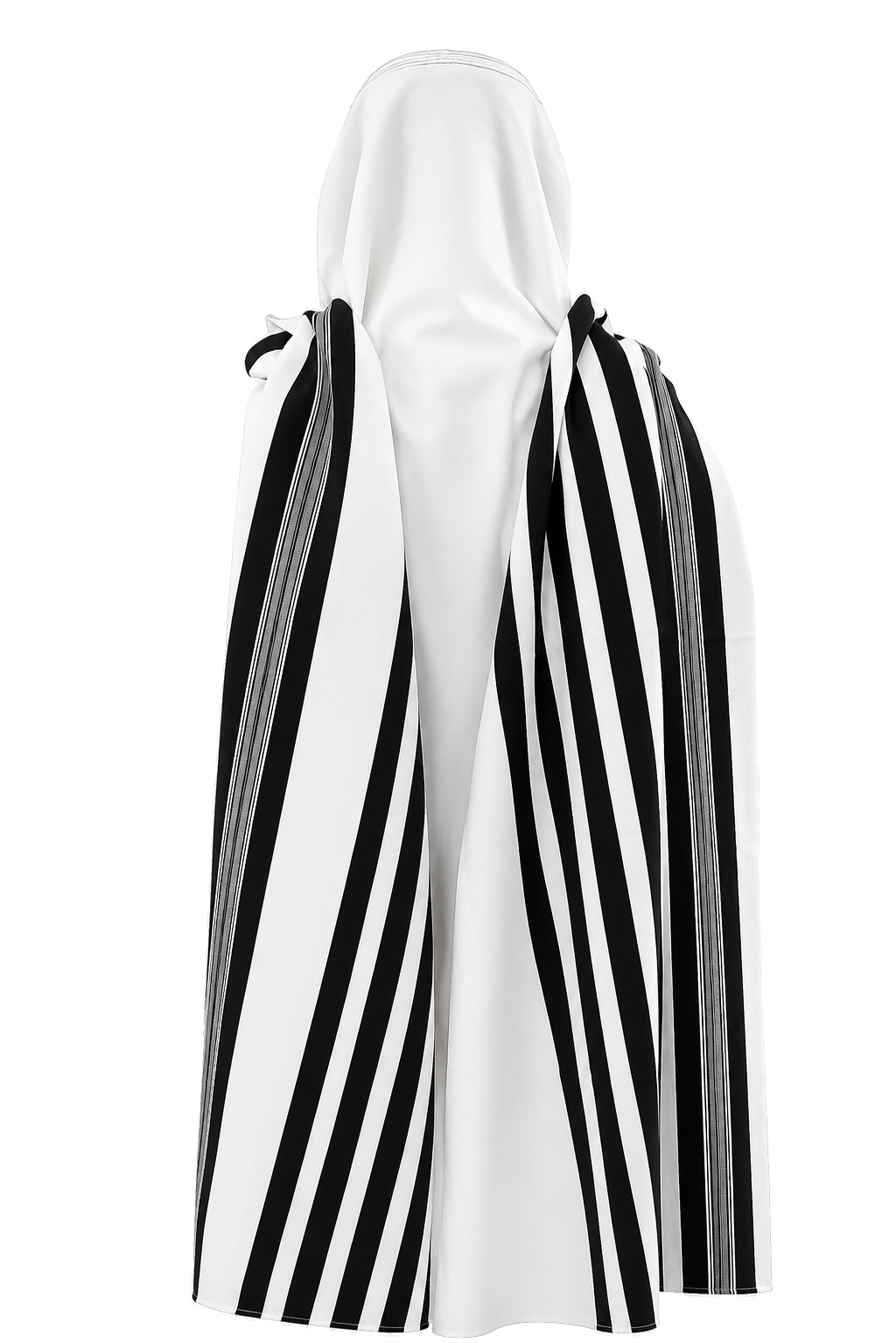
Typical modern Ashkenazic woolen tallit with a pattern of five black stripes and a cluster of thinner stripes nearer the edge
Courtesy of Ben’s Tallit Shop, Modi’in Illit, Israel

Early twentieth-century Ukrainian tallit with “Spanier Arbet” heavy metallic embroidery on the atarah and four corners
Photo © Israel Museum, Jerusalem, by Mauro Maliani

1920s postcard of a tallitot peddler, “Der Talleisim Hendler,” by Hayyim Goldberg
Courtesy of William A. Rosenthall Judaica Collection, College of Charleston Libraries, Charleston, SC
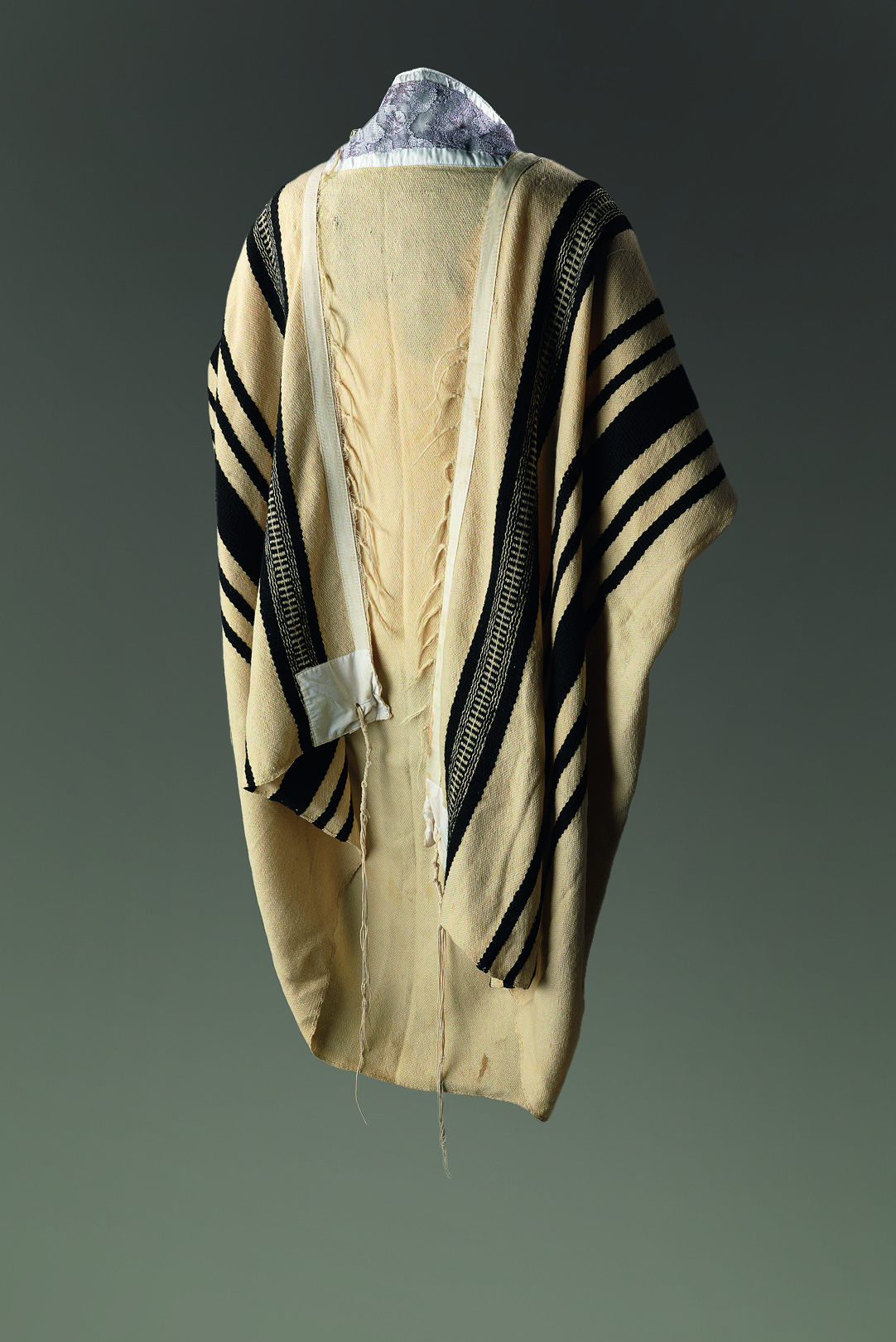
“Turkish” tallit, early twentieth century. Heavier tallitot of this type are popular among various Chassidic groups. They are made from coarsely woven, unbleached wool imported from Tunisia, once part of the Ottoman Empire, hence the name Turkish. Photo © Israel Museum, Jerusalem, by Eli Posner
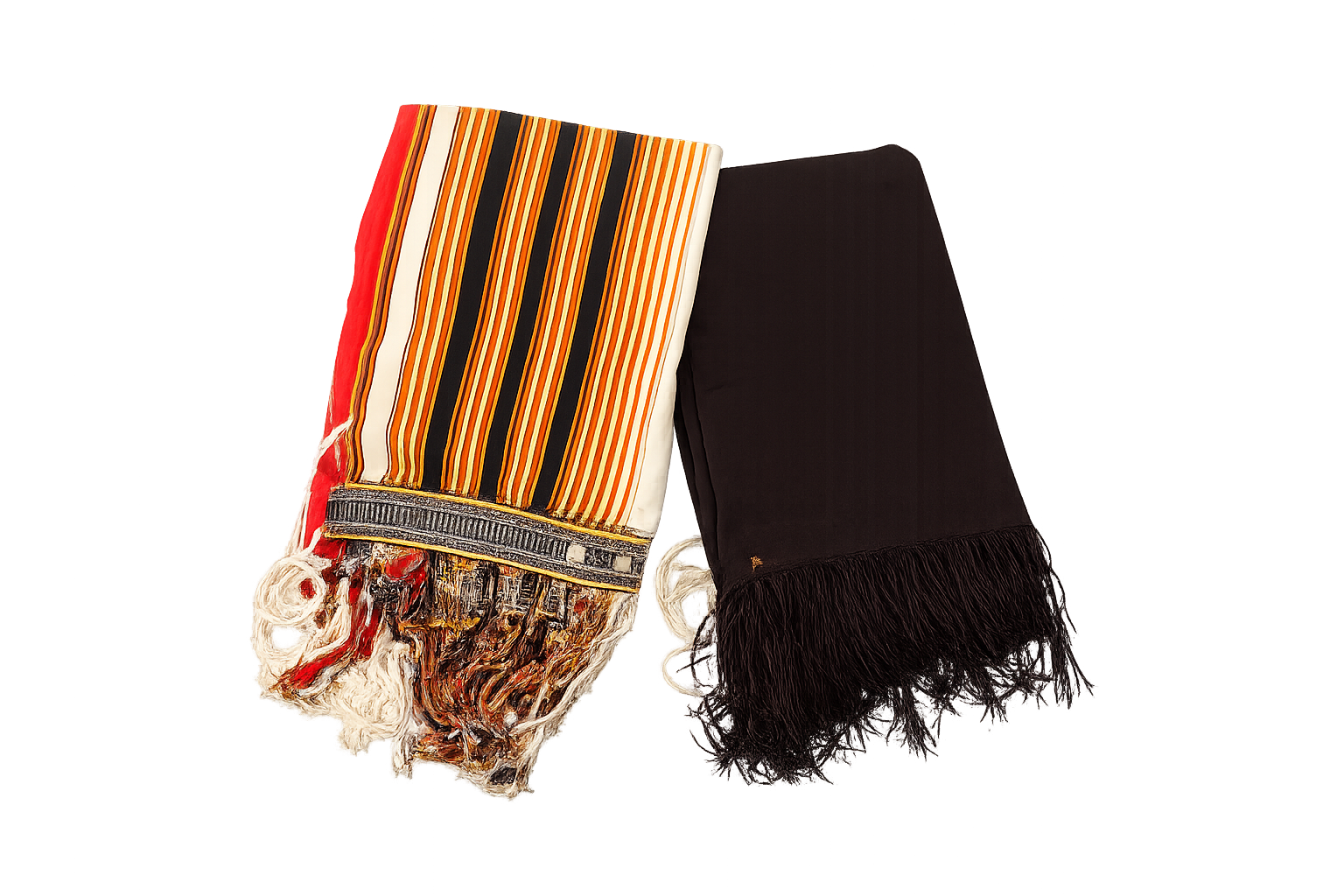
In Southern Yemen, Jewish men wore boldly striped tallitot, while those in Sana’a, the western mountain region of Yemen, and the Central Plateau, in the mountainous interior of the country, wore a tallit of refined black wool on Shabbat and yamim tovim. Courtesy of Sotheby’s, New York

Contemporary silk tallit, with tzitziyot knotted according to the Italian Jewish rite, embellished with graceful hand-knotted fringes
Courtesy of Talled di Seta, Rome, Italy

Tallit katan that refusenik Yosef Mendelevich fashioned for himself from a scarf during his years of imprisonment in the Soviet Union. Still unfamiliar with the details of the halachah, he threaded the tzitziyot through the garment itself. Courtesy of the Wolfson Museum of Jewish Art, Hechal Shlomo, Jerusalem

A member of the Beta Israel community of northern Ethiopia weaving a tallit on a traditional handloom. Weaving tallitot is a unique skill and spiritual tradition historically practiced by Ethiopian Jewish men. Courtesy of Dr. Ari Greenspan

Child-size tallit katan in luminous blue satin, richly embroidered with gold thread and decorated with scrolling floral motifs and pomegranates
Courtesy of Musée d’Art et d’Histoire du Judaïsme, Paris. Photo © RMN-Grand Palais–mahJ / Gilles Berizzi
Notes
1. The Jewish Wardrobe, ed. Esther Juhasz (Jerusalem, 2012).
2. Several reasons are given in rabbinic sources for adding an atarah, among them that once one of the edges has been designated as the top, it should always be taken that way and not downgraded. Also, there is some disagreement among rabbinic sources if the main part of the tallit is that which covers the head, or the part that covers the torso, which is why some add a decorated fabric strip around the middle of the tallit, in addition to the decorative top, as a compromise. See Daniel Sperber, Minhagei Yisrael, vol. 7 (Jerusalem, 1998), pp. 82–89.
3. Compare Tehillim 104:2.
I am grateful to Sharon Lieberman Mintz of Sotheby’s New York; Professor Shalom Sabar of the Hebrew University; Gabriel Goldstein, senior consultant at the Yeshiva University Museum; Benjamin Garson of Ben’s Tallit Shop; Dora Piperno of Talled di Seta; Johanna Diane of the Wolfson Museum of Jewish Art; Shloime Eichler; Rebbetzin Esther Krausz; Danny Levine; and Dr. Don Kristt for their help in preparing this article. I also thank the following staff members of various museums and libraries for their invaluable assistance in securing photographs: Tyler Mobley and Mary Jo Fairchild (Charleston); Carolyn Cruthirds (Boston); Christine Gervais and Marty Stein (Houston); Nicolas Feuillie (Paris); and Nili Luria (Jerusalem).
A Note About the Photographs
Although we have illustrated manuscripts from as early as the thirteenth century that show men wearing a tallit, the oldest tallitot pictured here date no earlier than the 1700s. The lack of earlier examples is due to two factors: the rapid natural decay of organic fibers like wool and silk, due to moisture, mold and insects; and the fact that most men’s tallitot were buried with them.
David Olivestone is a contributing editor of Jewish Action. His previous articles in this series include the artistry of etrog boxes and of Shabbat lights.
In This Section
The Artistry of the Tallit by David Olivestone
Out of the Blue: Return of Techelet by Dr. Ari Greenspan