

Rabbi Jacob Joseph, the chief rabbi of New York, is a cautionary tale of the limits of religious authority in America. The First Amendment that has done so much to protect Judaism in the United States also blocks government-sponsored rabbis. The effort to unify Orthodox Jewish life without the levers of government made this an especially interesting moment in American Jewish history. In that way, Rabbi Joseph’s career represents an important turning point in Orthodox Jewish life in the United States.
Rabbi Jacob Joseph’s appointment in 1888 by New York’s Association of American Orthodox Hebrew Congregations to serve as chief rabbi of its eighteen congregations was a long time in coming. America’s Jews, as historian Abraham Karp has written, had agitated for a chief rabbi since the 1860s. The search included luminary candidates such as the Malbim and Rabbi Tzvi Hirsch Rabinovitch, son of Rabbi Yitzchak Elchanan Spektor. In the end, Rabbi Jacob Joseph, maggid of Vilna, answered the call. His American sojourns, however troubling, were formative in the history of American Orthodox Judaism.
Rabbi Jacob Joseph was born in 1840. A disciple of Rabbi Yisrael Salanter, Rabbi Joseph also studied in the Volozhin yeshivah. Known as “Reb Yankev Charif,” Rabbi Joseph had a sharp mind and wit that rendered him a celebrated orator. He held several positions before his election as maggid of Vilna, “Lithuania’s Jerusalem.”
Rabbi Joseph was appointed chief rabbi of New York (with a Jewish population perhaps as large as 200,000) after the death of Rabbi Abraham Ash (1813–1887) of the Beth Hamidrash Hagadol on New York’s Lower East Side. Led by the leaders of Beth Hamidrash Hagadol, the Association of American Orthodox Hebrew Congregations could not achieve a consensus among all traditional Jews in New York. Hence, not everyone considered Rabbi Joseph New York’s chief rabbi. They had that right, since, unlike in Europe, the US government did not appoint rabbis or ministers to official posts. If America’s Jews were to accept Rabbi Joseph as their top rabbinic leader, it would have to be an “opt-in,” a voluntary appointment of authority.
The Americanized Jews of Manhattan didn’t appreciate Rabbi Joseph’s style of Yiddish oration and considered him a “greenhorn.”
One of the major challenges was that “Eastern Europe,” as historians (myself included) refer to this massive wave of migration at the turn of the century, lacks a particular precision. The Orthodox Jews of New York and elsewhere didn’t consider themselves “Eastern European Jews.” No, they viewed themselves as landsmen of much smaller areas. As the historian Moses Rischin long ago outlined, the Romanian Jewish immigrants moved to its own section of the Lower East Side—as did the Jewish Hungarians, Galicians, Lithuanians and Russians. Each had its own customs and, to the chagrin of those who wished to unite these groups, expectations for the rabbinate.
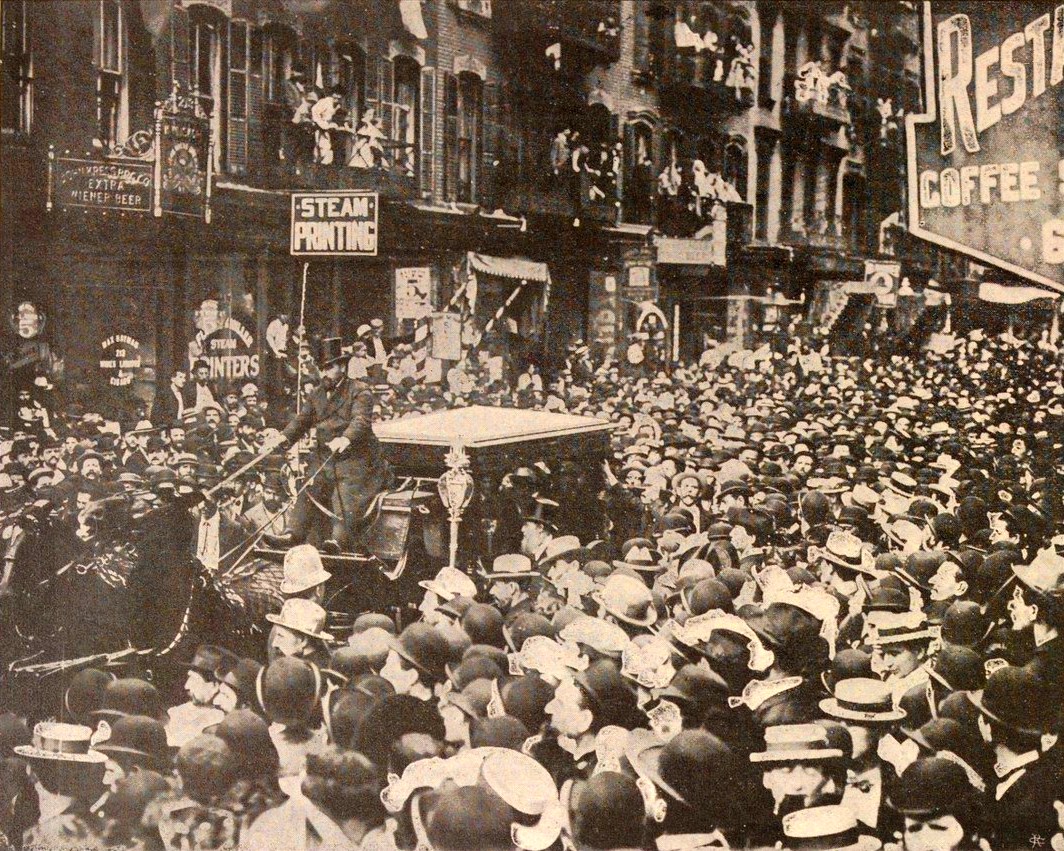
Perhaps as many as 100,000 people attended Rabbi Joseph’s funeral—a gesture to the potential of Rabbi Jacob Joseph’s appointment and as a symbol of Jewish immigrant solidarity.
But insiders were still optimistic that Rabbi Joseph could be a bridgebuilder. They eagerly fundraised to meet Rabbi Joseph’s demands for a six-year contract of a significant wage and an advance of payment to make arrangements for his family’s Atlantic travels. But Rabbi Joseph struggled from the outset. At his first discourse in July 1888, remembered the journalist Abraham Cahan, “some of the very people who drank in his words thirstily in Vilna left the synagogue in the middle of his sermon.” Rabbi J. D. Eisenstein, an important figure within the rabbinic world of the Lower East Side, wrote about Rabbi Joseph that “he did not satisfy his audience here.” The Americanized Jews of Manhattan didn’t appreciate Rabbi Joseph’s style of Yiddish oration and considered him a “greenhorn.”
Rabbi Joseph also faced opposition from the local rabbinate. This, importantly, relates to the effort to unify Orthodox groups and practices. Upon Rabbi Joseph’s arrival, the New York Tribune published a column entitled “Will He Be an Autocrat?” While Rabbi Dr. Henry Pereira Mendes, a founder of the Orthodox Union, had “kind words,” most of the rabbinic leaders cited in the lengthy column objected to the institution that would have them subservient to a newcomer. The local butchers also resented Rabbi Joseph’s tax on meat. His attempts to standardize kosher standards and burial customs were met with trenchant resistance. Historians Jeffrey Gurock and Menachem Blondheim, among others, have demonstrated how near impossible it was for Rabbi Joseph to gain a foothold in the religious marketplace of American Judaism. Concluded Blondheim: “Defeated and abandoned, both physically paralyzed and spiritually spent, a pauper Rabbi Joseph would pass away in New York on 22 July 1902.”
The tragic circumstances of Rabbi Joseph’s chief rabbinate convinced American Orthodoxy to seek other forms of organization. In June 1898, rabbis and lay leaders representing fifty congregations met at Shearith Israel in New York to form the Orthodox Jewish Congregational Union of America, later renamed the Union of Orthodox Jewish Congregations of America (also known as the Orthodox Union). These leaders convened to support the “Judaism we love so well” and to create a federation-style governance for Orthodox synagogues. This was a significant departure from the chief rabbinate approach that had by then proven unworkable in America.
Another iteration of rabbinic leadership was established after Rabbi Joseph’s funeral. Perhaps as many as 100,000 people attended the funeral—a gesture to the potential of Rabbi Joseph’s appointment and as a symbol of Jewish immigrant solidarity. After the burial, a large group of Eastern European–trained rabbis met to form the Agudath Harabbonim. Their goal to increase rabbinic authority was the same as the men who hired Rabbi Joseph in 1888, but the strategy was, of course, different.
Rabbi Joseph’s chief rabbinate did not endure. Yet the questions it raised about authority, unity and organization would define Orthodox Jewish life in America for decades to come. The formation of institutions, such as the Orthodox Union, grew directly out of the challenges he faced. His story, however painful, became part of the foundation on which American Orthodoxy was built.
Rabbi Dr. Zev Eleff is president of Gratz College and professor of American Jewish history.
In This Section
Celebrating 250 Years of America: The Orthodox Jewish Experience
Reflections on Orthodox Jewish Life in America by Rabbi Dr. Jacob J. Schacter
Why American Jewish History Matters: The Orthodox Experience by Rabbi Dr. Zev Eleff
America and the Problem of Opportunity, a conversation with Rabbi Yaakov Glasser
The Early Years of American Orthodox Judaism: A Historical Timeline
1830s–1860s: Pre–Civil War/Early Nineteenth Century
Moses Seixas (1744–1809)—The Promise of Liberty by Dr. Jeanne Abrams
Aaron Lopez (1731–1782)—Faith Before Fortune: Jewish Life in Colonial America by Saul Jay Singer
1830s–1860s: Pre–Civil War/Early Nineteenth Century
Isaac Leeser (1806–1868)—Champion of Orthodoxy by Rabbi Dr. Zev Eleff
Rebecca Gratz (1781–1869)—A Life of Giving by Dr. Melissa R. Klapper
1870s–1930s: Post–Civil War through Early Twentieth Century
Rabbi Jacob Joseph (1840–1902)—The Tragic Tale of New York’s Only Chief Rabbi by Rabbi Dr. Zev Eleff
Rabbi Herbert S. Goldstein (1890–1970)—The Maverick Rabbi by Rabbi Aaron I. Reichel
Faith on the Frontier: Orthodox Women of the Wild West by Dr. Jeanne Abrams
The American Story in the Responsa: She’eilos from the New World by Rabbi Moshe Taub