
Isaac Leeser (1806–1868)—Champion of Orthodoxy
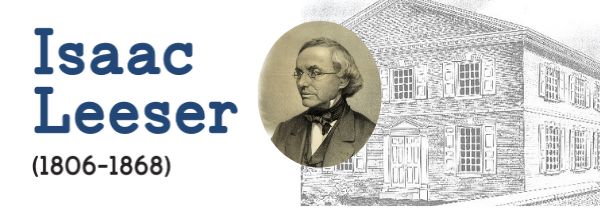
Portrait of Isaac Leeser courtesy of the Library of Congress, Prints & Photographs Division
In the aftermath of the Civil War, Reverend* Isaac Leeser charged Reform Jewish leaders with causing “disunion.” In 1867, for a Northerner, there was no more charged word in the English language. “Our old opponents,” preached Leeser, perhaps American Orthodoxy’s greatest champion at that moment, “also take part in the disunion, and uniformly rejoice when they see a chance of a hope for the introduction of their views into our councils.”
Leeser was beside himself with the Reformers’ introduction of new prayer books, the omission of the second day of Jewish holidays, and recent rumors that Reform leaders wished to remove gitten, the rite of divorce—a decision that would limit who Orthodox Jews could marry within the Reform community. Reformers did this, accused Leeser, even though they “no doubt believe that modern reform is a deviation from Judaism and an approximation to their [personal] doctrines.”
As a religious leader, translator, newspaper editor and public spokesman, Leeser is a crucial figure in the history of Orthodox Judaism in the United States. The lodestar for a generation of traditional Jews in the United States, he appeared at a pivotal moment. His career coincided with the rapid growth of the American Jewish population from 3,000 to about 160,000 women and men.
Isaac Leeser was born in Westphalia, Prussia, in 1806. Perhaps the greatest influence on Leeser, who was orphaned at a young age, was Rabbi Abraham Sutro, the chief rabbi of Münster. Rabbi Sutro was an outspoken opponent of religious reform. Leeser got an advanced Torah education in Münster—although he never received semichah—before migrating to Richmond, Virginia, in May 1824. There, Leeser lived with his uncle, worked for him and helped lead the local synagogue. Leeser gained a certain level of prominence after penning a defense of his coreligionists amid increased anti-Jewish hostility and missionizing.
In 1829, Leeser’s literary output earned him an offer to serve as minister and chazzan (the main religious functionary) of Congregation Mikveh Israel in Philadelphia, Pennsylvania, a position that required a certain level of Torah knowledge, which was not so common in those days. Established toward the end of the colonial era, Mikveh Israel, cut from the proud Spanish-Portuguese tradition, was one of the first congregations in the United States, although its membership was significantly depleted after the Revolutionary War.
The lodestar for a generation of traditional Jews in the United States, he appeared at a pivotal moment.
At Mikveh Israel, Leeser was a pioneer. His biographer, Lance Sussman, assembled a list of Leeser’s “firsts.” In the context of American Judaism, Leeser is credited with the introduction of the weekly sermon (1830); first translations of the Sephardic (1837) and Ashkenazic (1848) prayer books and Pentateuch (1853); first Hebrew primer (1838) for Sunday school children; first longstanding monthly Jewish newspaper (1843); and first, although very short lived, Jewish theological school in the United States (1867). Each of these accomplishments provided traditional Jews with the material and wherewithal to fortify their faith in the United States. Leeser also supported the efforts of the philanthropist Rebecca Gratz, also of Philadelphia.

Isaac Leeser published the first English translation of the Pentateuch in 1853. Courtesy of Internet Archive
Leeser had a national reach. In the pages of his monthly newspaper, the Occident, Leeser communicated with Jews, as historian Shari Rabin put it, on the burgeoning American frontier. He often traveled to these upstart communities to dedicate new synagogues and reinforce Orthodox practice. Something of a polemicist, he used these occasions to rail against the nearby Reform congregation for introducing mixed pews or shortening the Shabbat service, toning down the prayers’ emphasis on the coming of the Messiah or the return to Zion.
Leeser’s newspaper connected like-minded Jews throughout the United States. In time, Leeser’s newspaper shifted from a focus on protecting Jewish rights in the young Republic to defending Orthodox Judaism against the rise of public reformers such as Rabbis David Einhorn, Max Lilienthal and Isaac Mayer Wise. For instance, Wise convened a group of leaders in 1855 and released a statement that seemed to devalue the authority of the Talmud. Leeser slammed Wise for his assault on “traditional theology.”
Ever the optimist, Leeser wrote frequently about the formation of a “synod” or rabbinical body that could help mediate the widening differences between Orthodox and Reform leaders. Eventually Leeser gave up hope for this, coming around to the less sanguine positions of other Orthodox exponents such as Rabbi Abraham Rice (Baltimore) and Rabbi Morris Raphall (New York).
If Orthodoxy would take root in American soil, it would be because figures like Isaac Leeser planted it deliberately and tended it with care.
On the other hand, Leeser experienced many disappointments. In 1850, he became embroiled in a tug-of-war for religious authority at Mikveh Israel. Despite the religious leader’s increased national prominence, the parnas (president) and trustees refused to grant Leeser a lifetime contract and continued to oversee his sermons and projects. Leeser was crushed. He felt that his heroics on behalf of Orthodox Judaism merited far more leeway at home. He wanted the freedom to not worry about his finances and desired autonomy to preach from his pulpit without first submitting to lay leaders for approval. As a historic synagogue, Mikveh Israel provided Leeser with status to fight on behalf of that community’s shared beliefs. Deeply dismayed, Leeser resigned and, together with his followers, established a small congregation in Philadelphia. On this score—namely, the battle for religious authority in the United States—Leeser was on the same side as all rabbis and ministers who agitated for power against the long tradition of lay authority in American Judaism, a battle that would define American Orthodoxy for generations.
Leeser also never married. Several of his overtures to Rebecca Gratz (who also never married) were unrequited. In his dealings with Reform, Leeser was on the receiving end of some unfair ad hominem attacks. The trio of rabbinic reformers cited above, for instance, held traditional clerical credentials (of varying degrees) from Europe and often belittled Leeser’s scholarly stature. But Leeser remained resolute and confident in his knowledge of traditional Jewish texts. Throughout the highs and the lows of his life, Leeser maintained a close circle of followers and students who, in turn, provided him with the determination to continue his work.
Isaac Leeser died in 1868. He was mourned in the Jewish press—by Orthodox and Reform voices alike—as a tireless champion of American Jewish life. Members of the so-called Philadelphia Group, who would go on to establish the Jewish Publication Society and other enduring institutions, credited Leeser’s mentorship and vision. His student, Judge Mayer Sulzberger, called him a “pioneer” of American Judaism—a word that captures his legacy well. If Orthodoxy would take root in American soil, it would be because figures like Isaac Leeser planted it deliberately and tended it with care. That achievement secures his place as an indispensable pioneer of American Orthodox Judaism.
Rabbi Dr. Zev Eleff is president of Gratz College and professor of American Jewish history.
In This Section
Celebrating 250 Years of America: The Orthodox Jewish Experience
Reflections on Orthodox Jewish Life in America by Rabbi Dr. Jacob J. Schacter
Why American Jewish History Matters: The Orthodox Experience by Rabbi Dr. Zev Eleff
America and the Problem of Opportunity, a conversation with Rabbi Yaakov Glasser
The Early Years of American Orthodox Judaism: A Historical Timeline
1830s–1860s: Pre–Civil War/Early Nineteenth Century
Moses Seixas (1744–1809)—The Promise of Liberty by Dr. Jeanne Abrams
Aaron Lopez (1731–1782)—Faith Before Fortune: Jewish Life in Colonial America by Saul Jay Singer
1830s–1860s: Pre–Civil War/Early Nineteenth Century
Isaac Leeser (1806–1868)—Champion of Orthodoxy by Rabbi Dr. Zev Eleff
Rebecca Gratz (1781–1869)—A Life of Giving by Dr. Melissa R. Klapper
1870s–1930s: Post–Civil War through Early Twentieth Century
Rabbi Jacob Joseph (1840–1902)—The Tragic Tale of New York’s Only Chief Rabbi by Rabbi Dr. Zev Eleff
Rabbi Herbert S. Goldstein (1890–1970)—The Maverick Rabbi by Rabbi Aaron I. Reichel
Faith on the Frontier: Orthodox Women of the Wild West by Dr. Jeanne Abrams
The American Story in the Responsa: She’eilos from the New World by Rabbi Moshe Taub