
Moses Seixas (1744–1809)—The Promise of Liberty

In the summer of 1790, the United States was still an experiment. The Constitution had only recently taken effect, and the meaning of “liberty” remained, in many ways, untested. For the tiny Jewish community of Newport, Rhode Island, the question was urgent: Would the new republic merely tolerate Jews, or would it recognize them as full and equal citizens?
On August 17, 1790, Moses Mendes Seixas, the warden, or chief lay leader, of Congregation Yeshuat Israel in Newport, Rhode Island, today known as the Touro Synagogue (which still stands at the center of Newport’s downtown), seized a historic opportunity. President George Washington was visiting Newport, along with his Secretary of State Thomas Jefferson, to mark Rhode Island’s belated ratification of the Constitution, the last state to do so, as part of a goodwill tour to demonstrate appreciation for that ratification. Seixas presented him with a letter on behalf of the congregation, one that would help define religious liberty in America.
A Jewish Leader in a New Nation
Seixas was no marginal figure. Born in New York in 1744 to a family of Sephardic and Ashkenazic descent, he embodied the layered story of early American Jewry. Seixas’s paternal ancestors had escaped the long arm of the Inquisition in Portugal. His father, Isaac Mendes Seixas, had fled to New York via London and Barbados in the 1730s and later married Rachel Levy, daughter of a wealthy Ashkenazic immigrant, cementing the Jewishly observant family’s position as part of the American Jewish elite. Moses Seixas was raised in New York. The family numbered eight children: two girls and six boys (two of whom died in infancy). In 1765, the Isaac Seixas family moved for a time to Newport. Moses, however, settled there permanently in 1770. By that time, he was part of a small but economically significant Jewish community.
Seixas became a successful Newport merchant and banker, a co-founder of the Bank of Rhode Island. Yet his most enduring role was communal. In the voluntary position of warden of the shul, Seixas effectively oversaw the financial, charitable and religious life of the congregation and served as the head of the Newport Jewish community. By the time of the American Revolution, about twenty-five Jewish families resided in Newport, and Jews were spread across the colonies, primarily in New York, Rhode Island, Pennsylvania, South Carolina, and Georgia. In total, no more than 2,000 Jews lived among a population of roughly 2.5 million.
Though Seixas and other Jews of Newport were financially successful, they were concerned that their freedom to worship could one day be curtailed. They had reason to worry. Jews had been expelled from various European countries over the centuries and had suffered ongoing religious persecution.
The stakes were clear. Jews had lived for centuries at the mercy of rulers who could rescind protections at will. The American Revolution offered something different—but would it endure?
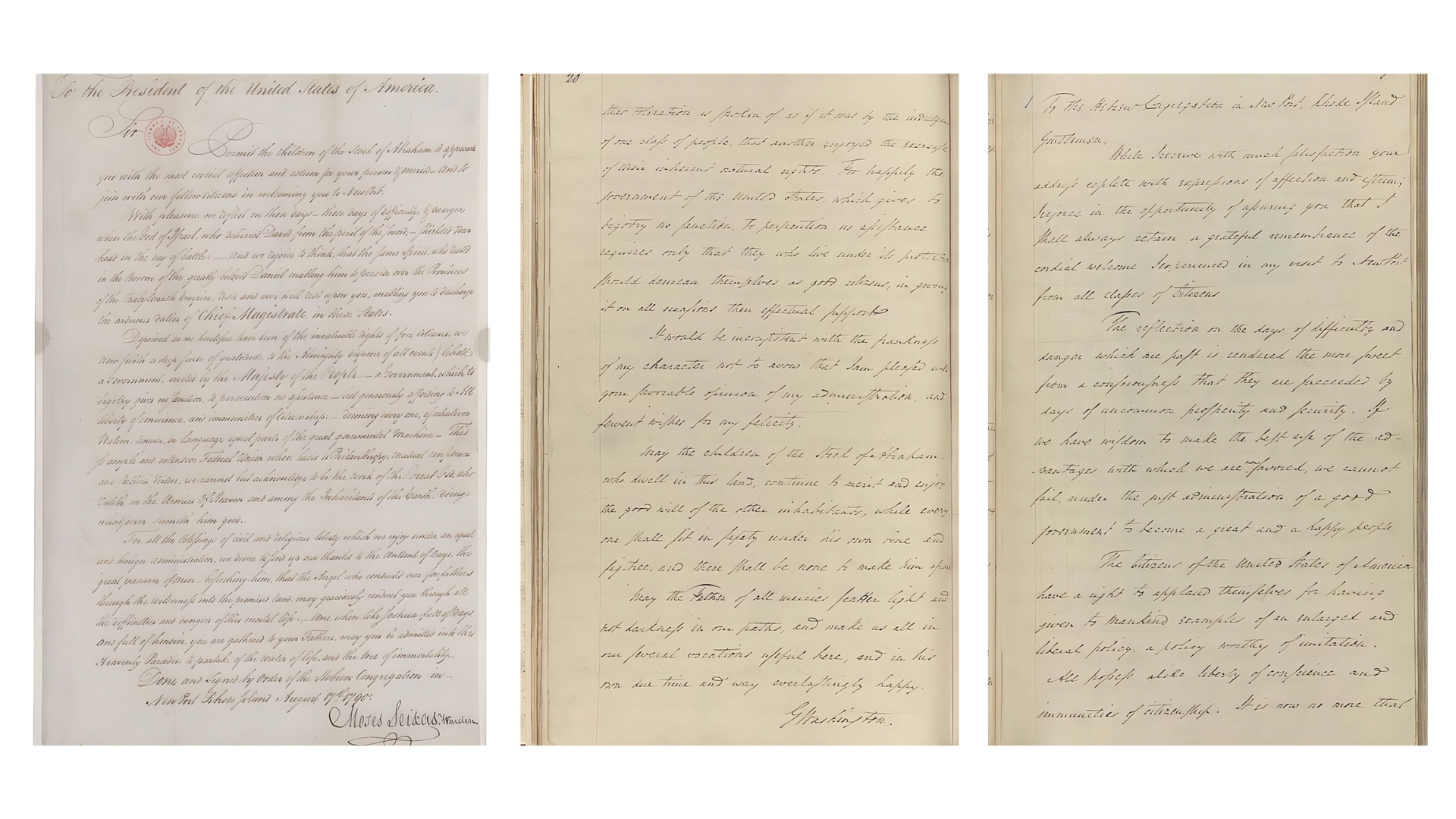
Letters written between Moses Seixas and George Washington, in which Washington famously wrote, “All possess alike liberty of conscience and immunities of citizenship.” Courtesy of the library of Congress, Prints & Photographs Division
“To Bigotry No Sanction”
Seixas’s letter to Washington was gracious but pointed. It acknowledged the full British rights. It acknowledged the full rights that the colonists had been denied.
Deprived as we heretofore have been of the invaluable rights of free Citizens [under the British], we now, with a deep sense of gratitude to the Almighty disposer of all events, behold a Government, erected by the Majesty of the People—a Government, which to bigotry gives no sanction, to persecution no assistance—but generously affording to All liberty of conscience, and immunities of Citizenship.
This was not mere flattery. It was a theological and political claim. Seixas invoked Divine Providence while subtly pressing the president to affirm that Jews stood fully within the promise of the new republic. Would America offer equality or simply toleration?
Washington’s Reply
Washington responded within days. His letter remains one of the foundational texts of American religious freedom. He affirmed and expanded upon Seixas’s central argument, and his response became pivotal for all religious groups, but particularly for Jews, or “the children of the Stock of Abraham,” as both Seixas and Washington termed them.
For the tiny Jewish community of Newport, Rhode Island, the question was urgent: Would the new republic merely tolerate Jews, or would it recognize them as full and equal citizens?
Echoing and expanding Seixas’s language, he wrote: “All possess alike liberty of conscience and immunities of citizenship. It is now no more that toleration is spoken of, as if it was by the indulgence of one class of people that another enjoyed the exercise of their inherent natural rights.”
With that sentence, Washington shifted the framework. Religious liberty was not a concession granted by a dominant majority. It was an inherent right. In a striking flourish, Washington closed with words drawn from the prophet Micah:
May the children of the stock of Abraham, who dwell in this land, continue to merit and enjoy the goodwill of the other inhabitants; while everyone shall sit under his own vine and fig tree, and there shall be none to make him afraid.
For a president addressing a tiny minority faith, the Biblical cadence was deliberate. Washington signaled that Jews were not outsiders asking for indulgence; they were citizens, secure in their rights as along as they upheld their responsibilities as Americans. Seixas and many Jews in the new United States found hope and reassurance in his words.
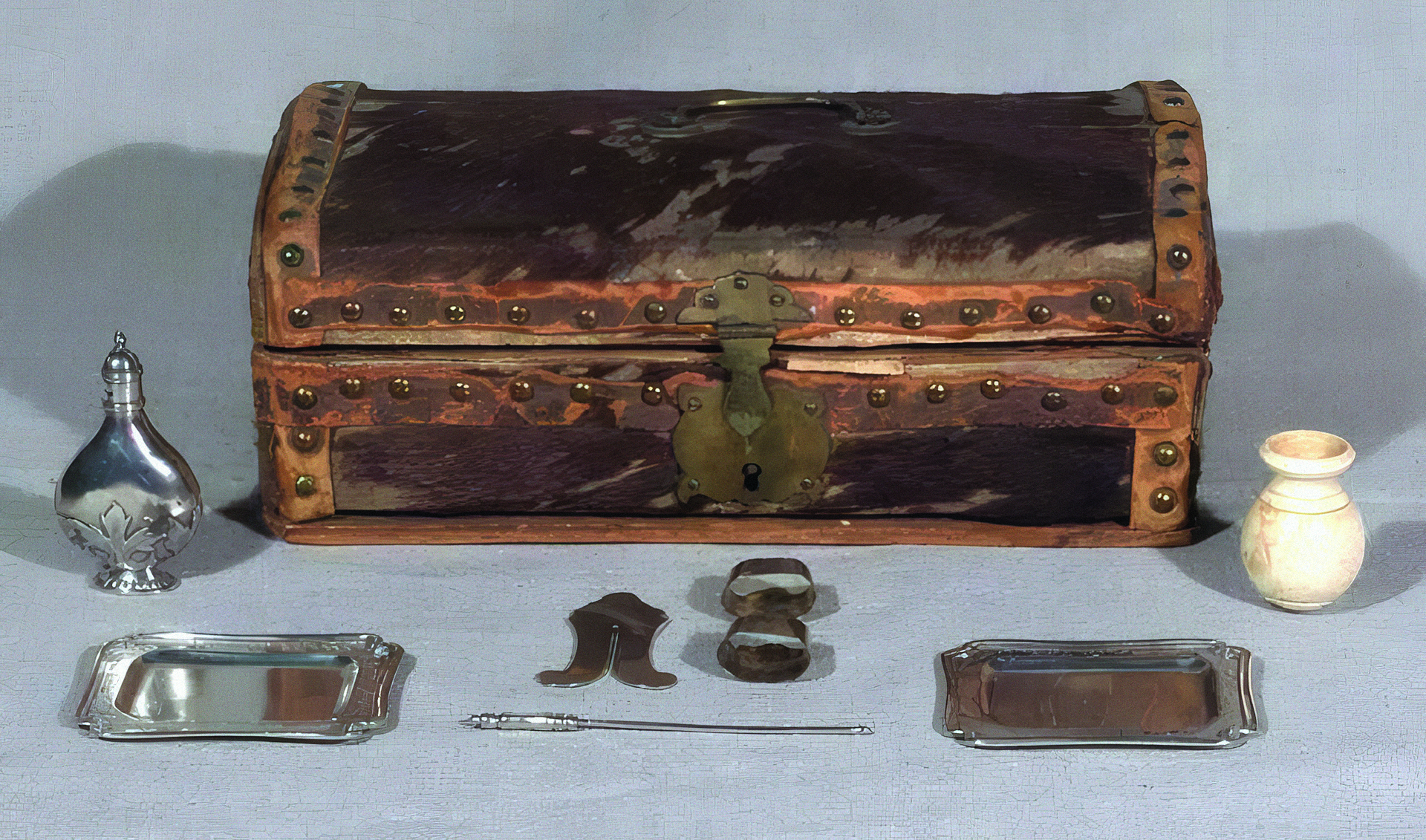
The Seixas family circumcision set. Courtesy of the American Jewish Historical Society
A Family of Builders
Seixas came from a remarkable family that helped build American Jewish life. Seixas married Jochebed Levy in 1770, and together they became the parents of eight children. His younger brother, Gershom Mendes Seixas, later became chazzan of the Shearith Israel Synagogue in Manhattan and an influential leader in his own right in the early days of the American Republic. He was present at Washington’s inauguration as the representative of the small American Jewish community and was the first Jewish trustee of Columbia College, now Columbia University. Another brother, Benjamin Mendes Seixas, born in Newport, became a prominent New York merchant and a founder of the New York Stock Exchange. The respected Supreme Court Justice Benjamin Cardozo was descended from the Seixas family on his mother’s side.
More Than a Letter
Seixas did not draft a constitutional amendment. He did not sit in Congress. Yet his initiative prompted a presidential statement that helped define the American understanding of church and state.
In pressing Washington for clarity, Seixas articulated a distinctly Jewish concern: that freedom must rest not on goodwill alone but on principle. Washington’s reply answered that concern with enduring force. America would not merely “tolerate” Jews. It would recognize their equal claim to citizenship.
Seixas passed away in 1809 at the age of sixty-six in New York City, at the home of a son-in-law, and was buried in the old Jewish cemetery on the Bowery. Newport’s newspaper eulogized him as a man of “unblemished reputation . . . without bigotry, zealous and uniform in the profession of his [Jewish] faith.” His life did not reshape the Constitution, but it helped secure something just as enduring: a public affirmation that in the United States, liberty of conscience was not a favor extended to Jews—it was their birthright as citizens.
Dr. Jeanne Abrams is professor emerita at the University of Denver. She served for many years as director of the University of Denver Rocky Mountain Jewish Historical Society and as curator of the Beck Archives of Rocky Mountain Jewish History. She is the author of six books and numerous articles in scholarly journals and popular magazines, and in 2023, she was inducted into the Colorado Authors’ Hall of Fame.
In This Section
Celebrating 250 Years of America: The Orthodox Jewish Experience
Reflections on Orthodox Jewish Life in America by Rabbi Dr. Jacob J. Schacter
Why American Jewish History Matters: The Orthodox Experience by Rabbi Dr. Zev Eleff
America and the Problem of Opportunity, a conversation with Rabbi Yaakov Glasser
The Early Years of American Orthodox Judaism: A Historical Timeline
1830s–1860s: Pre–Civil War/Early Nineteenth Century
Moses Seixas (1744–1809)—The Promise of Liberty by Dr. Jeanne Abrams
Aaron Lopez (1731–1782)—Faith Before Fortune: Jewish Life in Colonial America by Saul Jay Singer
1830s–1860s: Pre–Civil War/Early Nineteenth Century
Isaac Leeser (1806–1868)—Champion of Orthodoxy by Rabbi Dr. Zev Eleff
Rebecca Gratz (1781–1869)—A Life of Giving by Dr. Melissa R. Klapper
1870s–1930s: Post–Civil War through Early Twentieth Century
Rabbi Jacob Joseph (1840–1902)—The Tragic Tale of New York’s Only Chief Rabbi by Rabbi Dr. Zev Eleff
Rabbi Herbert S. Goldstein (1890–1970)—The Maverick Rabbi by Rabbi Aaron I. Reichel
Faith on the Frontier: Orthodox Women of the Wild West by Dr. Jeanne Abrams
The American Story in the Responsa: She’eilos from the New World by Rabbi Moshe Taub