
Rabbi Abraham Joseph Rice (1802–1862)—In Complete Isolation: The Struggle for Torah in America

“I dwell in complete isolation . . . without a teacher or a companion in this land whose atmosphere is not conducive to wisdom.”
With these words, written to his revered rebbi in Bavaria, Rabbi Abraham Joseph Rice described his early years in America. It was the 1840s. The Jewish community was growing. But religious observance was fragile, halachic infrastructure was nonexistent, and assimilation was rampant.
Rabbi Abraham Joseph Reiss (his name was later Americanized to Rice), who lived from 1802 to 1862, was not merely another immigrant rabbi; he was the first traditionally ordained rabbi to settle in the United States. What he encountered here—resistance, reform, loneliness and relentless responsibility—would define the challenges facing Orthodoxy in America for generations.
Rabbi Rice did not live to see a flourishing Orthodox infrastructure in America. The synagogue he helped build would eventually become Reform. The religious decline that pained him did not reverse in his lifetime.
And yet, he remained.
He remained when others compromised. He remained when he had to earn his livelihood with “the sweat of my brow.” He remained when he questioned whether a Jew could live in such a land. In doing so, he established something more enduring than an institution. He established the principle that authentic Torah Judaism could take root on American soil. The generations of Orthodox rabbis who followed did not enter a wilderness entirely uncharted. Rabbi Abraham Rice had already walked it.
Rabbi Rice’s accomplishments and failures are an overture for all that would be the fate of the Orthodox Rabbinate on the American scene for the next 100 years. Born in Gagsheim, Bavaria, a provincial town near Würzburg, Rabbi Rice would later study with two notable scholars, Rabbis Wolf Hamburger and Abraham Bing. At the age of thirty, Rabbi Rice became a Talmud instructor at the yeshivah in Zell, Germany. The leading Bavarian rabbis were concerned about the lack of religious guidance in the American wilderness, to where thousands of Bavarian Jews had emigrated. These rabbis encouraged Rabbi Rice to join his brethren in the United States.
In 1840, Rabbi Rice, his wife and his sister arrived in New York. Soon after his arrival, he followed the advice of his American acquaintances and settled in Newport, Rhode Island. Rabbi Rice aspired to become the spiritual leader of the historic Newport congregation, Yeshuat Israel. This synagogue was famous as it received the historic letter from George Washington which stated that “the children of the stock of Abraham” may happily live in this land “by right” and not by sufferance. However, Rabbi Rice soon learned, to his disappointment, that the Jewish community in Newport declined to a few people, and there was little chance of reviving the community at that time.
The rabbi returned to New York where he met Aaron Weglein, a landsman, who hailed from his birthplace. The latter had opened an iron foundry in Baltimore and also served as the president of Congregation Nidchei Yisroel. He invited Rabbi Rice to become its spiritual leader. Rabbi Rice would become the Stadt Rav, the ritual authority for the Baltimore community totaling over 300 families, mostly newly arrived Bavarian Jews.
The synagogue he helped build would eventually become Reform. The religious decline that pained him did not reverse in his lifetime.
Rabbi Rice’s sermons, preached in Judeo-German during the High Holy Days of 1840, presented his staunch Torah outlook regarding the relevancy of halachah. Evidently it aroused the ire of the non-observant. Soon, opponents of his viewpoints spread rumors to demean him. Rabbi Rice responded in his Shabbat sermon, delivered the last day of Chanukah, December 26, 1840:
Let my enemies take notice that there are no ways or means that they can devise which will deter or halt me. I am willing to offer myself and all I possess to bring G-d’s teachings to you . . . I am obliged[,] as your religious teacher, to point out to you your faults, for who can maintain that he is without a blemish? Let those who reject these teachings disseminate all sorts of fantasies about me. It is my love for you, which inspires me to bring the Word of G-d to you. I only need your confidence to accomplish this holy goal . . . .
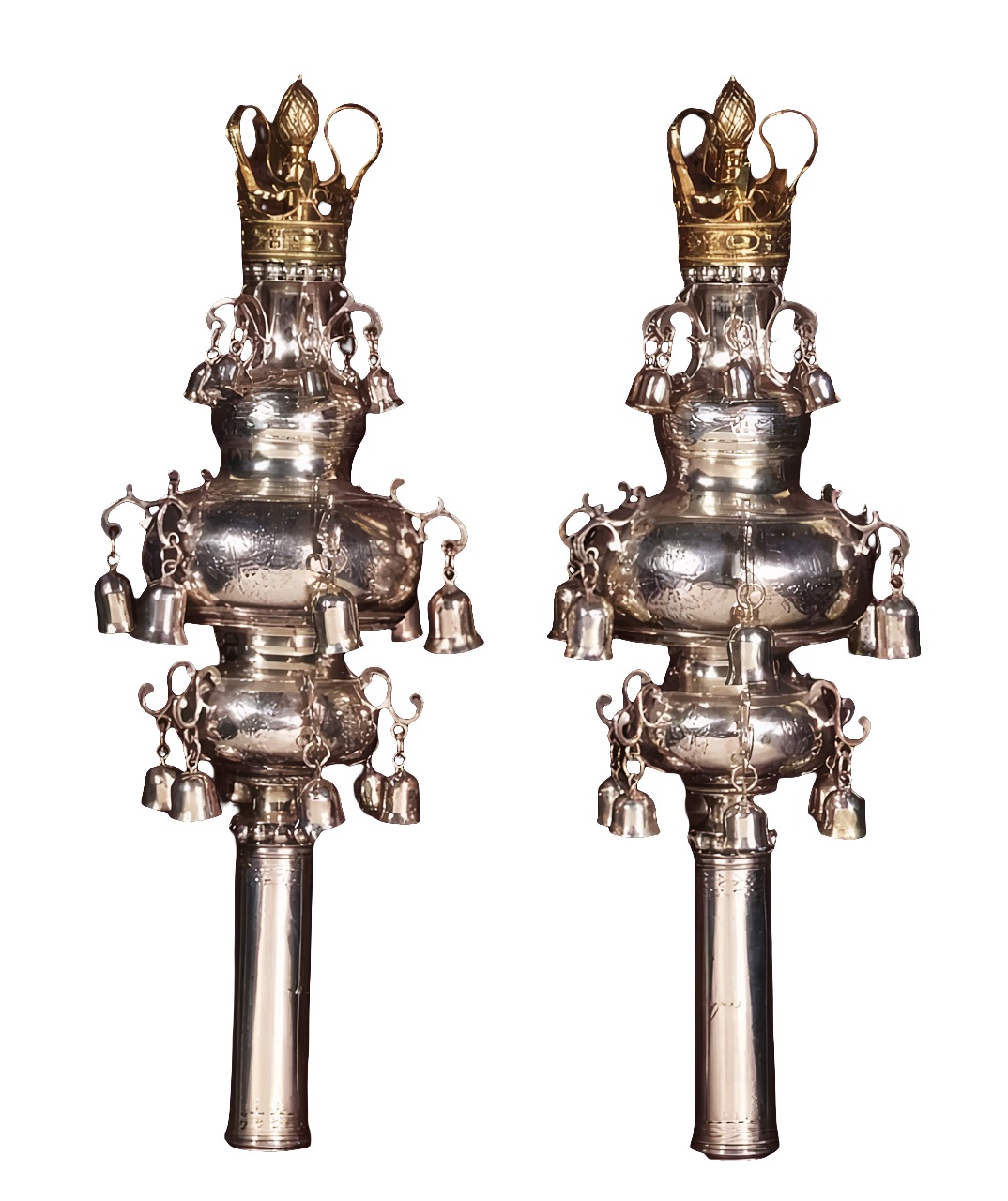
Silver rimonim (Torah finials) crafted in the mid-eighteenth century and used in Congregation Yeshuat Israel. Photos courtesy of the Library of Congress, Prints & Photographs Division
Rabbi Rice at first directed that those who did not observe Shabbat restrictions should not be honored with aliyot. He evidently did not take into account how many of his congregants were Shabbat desecrators. Rabbi Rice was forced to rescind his original directive and to allow non-Shabbat observers to be called to the Torah. He wrote the following depressing letter to his teacher, Rabbi Wolf Hamburger, part of which was cited earlier:
I dwell in complete isolation (obscurity) without a teacher or a companion in this land whose atmosphere is not conducive to wisdom; all religious questions (she’eilot) are brought to me for solution. I have to carry the full load on my shoulders and have to assume the authority to render decisions in Halachic questions in both private and public matters.
And one more thing I wish to disclose to you my revered master and teacher . . . and my soul weepeth in the dark on account of it, namely, that the character of religious life in this land is on the lowest level; most of the people are eating non-Kosher food, are violating the Shabbat in public . . . and there are thousands who have been assimilated among the non-Jewish population, and have married non-Jewish women. Under these circumstances, my mind is perplexed and I wonder whether a Jew may live in a land such as this.
Nevertheless in my own home—thank G-d—I conduct myself as I did in days of old in my native country. I study Torah day and night, and my devoted and G-d fearing wife is always standing by and helping me with all her strength, in spite of privation and difficulties. Yet in spite of all this, life has lost all meaning here on account of the irreverence and low estate of our people. Alas, therefore, my master and teacher, impart to me of your wisdom, and let me have your august opinion in the matter; for often times I have made up my mind to leave and go from here to Paris and to put my trust in the good Lord.
Rabbi Rice gradually made his peace with the religious situation and continued to minister to the needs of the growing community of Baltimore. He was encouraged by his association with Isaac Leeser, the chazzan and spiritual leader of Congregation Mikveh Israel in Philadelphia. Leeser encouraged Rabbi Rice to express his views in the Occident, the first general Jewish periodical published in the United States, from 1843 to 1869. The publication was dedicated to authentic Judaism, and Leeser served as its editor. Together with Rabbi Rice as a contributor, they challenged Reform innovations and defended Orthodoxy with forthrightness and skill. Reform leaders like David Einhorn and Isaac Mayer Wise found them to be formidable opponents.
In 1841, Rabbi Rice organized the first Hebrew school in Baltimore. In 1845, he celebrated the completion of the building of the first Jewish house of worship in Baltimore. Until then, religious services were conducted in quarters converted into synagogues. The new structure contained a mikveh as well as an oven for baking matzot. Rabbi Rice’s synagogue became known as the “Lloyd Street Shul” in accordance with its location. The membership increased as the Bavarian Jewish immigration to the United States intensified. However, the new reality also added dissension and conflict to the synagogue scene. Many members had been exposed to and influenced by American liberal ideas. The Reform movement was also appealing and beckoning to many of the recent arrivals. At first, these congregants requested some minor ritual changes. Gradually, they advocated for more major innovations. Rabbi Rice refused to compromise, as he viewed this as the initial steps to a total break with Orthodoxy. He was not incorrect, as the Lloyd Street Shul eventually became a Reform temple.
In 1849, the situation was so painful that Rabbi Rice resigned as the spiritual leader of the congregation. “I resigned,” he said, “because as a private citizen, I expect to have greater influence with the congregation.” Rabbi Rice became a merchant, at first in the dry-goods business and afterwards conducting a grocery. However, notwithstanding his retirement from the official rabbinate, many regarded him as their “rav umanhig.” In 1851, Rabbi Rice organized a small congregation where he officiated as the spiritual leader without compensation. In 1862, his initial congregation found itself without a rabbi. They once again turned to Rabbi Rice to accept the pulpit of Congregation Nidchei Yisroel. Isaac Leeser urged him to accept the call. He wrote to Rice: “We know of no one in the country on whose shoulders the dignity of rabbi could be more fittingly placed.” Rabbi Rice returned, but his second term of service lasted barely a few months, from June to October, as he passed away on October 29, 1862.
What he encountered here—resistance, reform, loneliness and relentless responsibility—would define the challenges facing Orthodoxy in America for generations.
Rabbi Rice was venerated by those who appreciated his piety and dedication to the study of Torah. His understanding of the American scene resulted in activities and viewpoints which helped strengthen authentic Judaism against the Reform innovations. Rabbi Rice urged his colleague Isaac Leeser to undertake a translation of the Bible into English. He correctly felt that the German edition, which was in vogue at the time, would not attract the younger Americanized generation. The result was the Leeser English Bible, the first traditional translation of the Bible in America.
When the influence of the liberal and Reform doctrines encouraged Jews to negate the practice of circumcision, Rabbi Rice was consulted on a series of problems relating to the burial of uncircumcised sons. Rabbi Rice declared that a boy who died before his thirteenth birthday is not in violation of that commandment and is entitled to a Jewish burial. However, circumcision must be performed symbolically prior to interment, as it is customary to do for an infant who died before his eighth day. Rice also ruled that the circumcised son of a gentile mother is still regarded as a non-Jew. The religion of the child is determined only by the mother’s status. In order for the child to enter into the Jewish faith, the brit must be followed by immersion in a mikveh.
When Isaac Mayer Wise, a prominent Reform rabbi, publicly rejected belief in the “Messiah” and “resurrection of the dead,” Rabbi Rice placed a ban of excommunication upon him. In the commotion that followed, Rabbi Rice declared:
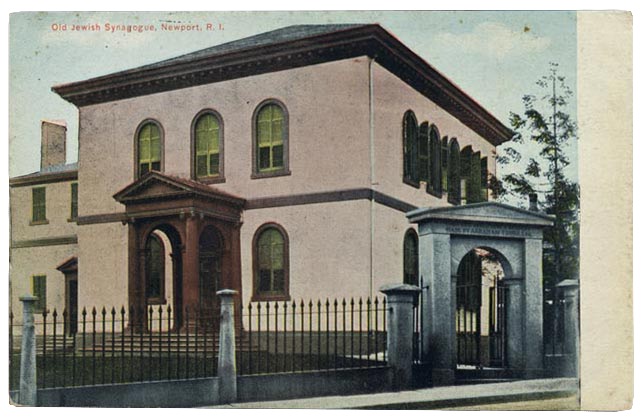
Congregation Yeshuat Israel (known as the Touro Synagogue today) in Newport, Rhode Island, in 1910.
I come forth only to do my duty as a true Israelite, to show to my brethren the iniquity of these doctrines, and to warn them not to go in these paths. Thank G-d!—my motives are good. I live not on the fat of religion; with the sweat of my brow I have to labour to maintain my family. I have no desire to be called a Rabbi or a Doctor, or a great man in Israel. I strive only to do justice to the sacred cause of my religion, to show how Israel will be deceived by these innovations.
Among the many halachic quandaries that he was called upon to decide was whether etrogim from the West Indies were acceptable. Another problem that concerned him was the kashrut status of shortening and the oils utilized in its manufacture. The procedure of draining blood from animals before shechitah was another question that required his guidance. It was believed that bloodletting before slaughter had a good effect upon the meat. Problems concerning the writing of gittin in certain cities were also sent to Rice. In many American cities, gittin were never written before. Since there was no precedent, Rabbi Rice had to establish how to write the text in relation to the spelling and the location of the city.
A plaque was placed in his synagogue which declared “Abraham J. Rice, first ordained rabbi in America, 1840. First rabbi of Baltimore Hebrew Congregation, 1840–1862.” The example of Rabbi Rice and his role on the American scene encouraged other ordained scholars to reach the United States. The next such spiritual leader was Rabbi Dr. Bernard Illowy (1814–1871). A student of the Chatam Sofer, he arrived in America in about 1852. While Rabbi Illowy served in a number of cities, he also was to become the spiritual leader of the Baltimore Hebrew Congregation (1859–1861).
Rabbi Rice never saw the flourishing of Orthodox life in America. But he stood his ground when he stood alone, and in doing so, made it possible for Orthodoxy to take root and, in time, thrive on these shores.
For additional information and sources, see:
1. Israel Tabak, “Rabbi Abraham Rice of Baltimore,” Tradition, 7 (1965), 100–120.
2. Rabbi I. Harold Sharfman, The First Rabbi (Malibu: Joseph Simon Pangloss Press, 1988).
3. Yitzhak Levine, “Rabbi Abraham Rice: America’s First Rabbi,” in Eli W. Schlossberg, My Shtetl Baltimore (Israel: Targum Publishers, 2017), 162–171.
Rabbi Dr. Aaron Rakeffet-Rothkoff is professor of rabbinic literature at Yeshiva University’s Caroline and Joseph S. Gruss Institute in Jerusalem. He is a noted scholar, author and teacher who has taught thousands of students throughout his over sixty years of teaching. His tenth book, entitled Philo in Washington Heights: A Memoir of Rabbi Dr. Samuel Belkin, will soon be published jointly by OU Press and Yeshiva University Press.
In This Section
Celebrating 250 Years of America: The Orthodox Jewish Experience
Reflections on Orthodox Jewish Life in America by Rabbi Dr. Jacob J. Schacter
Why American Jewish History Matters: The Orthodox Experience by Rabbi Dr. Zev Eleff
America and the Problem of Opportunity, a conversation with Rabbi Yaakov Glasser
The Early Years of American Orthodox Judaism: A Historical Timeline
1830s–1860s: Pre–Civil War/Early Nineteenth Century
Moses Seixas (1744–1809)—The Promise of Liberty by Dr. Jeanne Abrams
Aaron Lopez (1731–1782)—Faith Before Fortune: Jewish Life in Colonial America by Saul Jay Singer
1830s–1860s: Pre–Civil War/Early Nineteenth Century
Isaac Leeser (1806–1868)—Champion of Orthodoxy by Rabbi Dr. Zev Eleff
Rebecca Gratz (1781–1869)—A Life of Giving by Dr. Melissa R. Klapper
1870s–1930s: Post–Civil War through Early Twentieth Century
Rabbi Jacob Joseph (1840–1902)—The Tragic Tale of New York’s Only Chief Rabbi by Rabbi Dr. Zev Eleff
Rabbi Herbert S. Goldstein (1890–1970)—The Maverick Rabbi by Rabbi Aaron I. Reichel
Faith on the Frontier: Orthodox Women of the Wild West by Dr. Jeanne Abrams
The American Story in the Responsa: She’eilos from the New World by Rabbi Moshe Taub