
Rebecca Gratz (1781–1869)—A Life of Giving
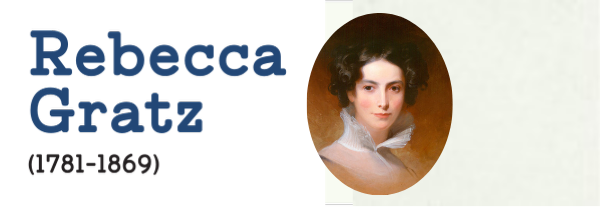
Portrait by Thomas Sully, 1831
In April 1838, Rebecca Gratz received a letter from her niece Miriam Gratz Moses Cohen that probably brought a smile to her lips. Miriam thanked “the Giver of all good things” for her aunt’s love and reported that her husband, Solomon, was busy preparing for Passover by “weighing out [the] Motsas” he had ordered from Savannah, Georgia, to supply their entire Jewish community in Georgetown, South Carolina.1 Rebecca, whose large and varied family lived all over the antebellum United States, was always glad to hear about her relatives’ Jewish lives. Born during the middle of the American Revolution, when there were fewer than 2,000 Jews in the thirteen British colonies, Rebecca died shortly after the end of the Civil War, when there were between 150,000 and 200,000 Jews in the United States. Throughout her long life, she was devoted to her family, to Jewish community and to her consistent values of education, religious devotion and public service.
Rebecca was the seventh of Michael and Miriam Simon Gratz’s twelve children, not all of whom lived to adulthood, as was all too common at the time. Her father and his brothers had left behind a distinguished rabbinic lineage in central Europe to pursue economic opportunity in the American colonies, where they prospered as merchants. Rebecca grew up in a wealthy household and was well-educated, as the daughters of many Philadelphia elites were in the new United States. Her family played a leadership role in Congregation Mikveh Israel, a synagogue founded in 1740 that used a Sephardic liturgy even though most of its members, like the Gratzes, were Ashkenazic. Rebecca faithfully attended services at Mikveh Israel throughout her life and worked on many communal projects with Isaac Leeser, who served as Mikveh Israel’s chazzan (the main religious functionary) from 1829 to 1850 and defended traditional Judaism in America. Like many of the other congregants, including most of the women, she knew little Hebrew, but English translations of both the siddur and Tanach were available in growing number in the mid-nineteenth century.
The elite Philadelphia women who dispensed material aid to the poor with one hand dispensed an evangelizing Protestantism with the other.
Building Jewish Institutions
The women of the Gratz family were heavily involved with philanthropic institutions in Philadelphia and beyond. Rebecca and a number of her female relatives were among the founders of the Female Association for the Relief of Women and Children in Reduced Circumstances (1801) and the Philadelphia Orphan Asylum (1815). Though she was valued by these organizations and remained committed to them throughout her life, Rebecca became increasingly concerned about their sectarian nature. The elite Philadelphia women who dispensed material aid to the poor with one hand dispensed an evangelizing Protestantism with the other, making it difficult for Jewish women and children to benefit from their assistance without compromising their religious beliefs. As a result, Rebecca also became a leader in establishing Jewish institutions to serve those in need in her own religious community. In 1819, she was the moving force behind the Female Hebrew Benevolent Society, which she later described as embodying the “good will, good wishes, and good words” of Jewish women who wanted to provide aid to other Jewish women and children, demonstrating the “spirit of charity in which the Female Hebrew Benevolent Society greets and claims kindred with every daughter of Israel.”2 Later in her life, she played an influential role in the establishment of the Jewish Foster Home (1855), an orphanage for Jewish children that had become increasingly necessary due to the influx of central and western European Jewish immigrants during the 1840s and 1850s.

Reports from the Hebrew Sunday School Society of Philadelphia in the 1880s
Inventing Hebrew School
Perhaps most famously of all, she also transformed American Jewish education when she started the Hebrew Sunday School Society (HSSS) in 1838. Based on the idea that formal, if supplementary, Jewish education was critical to the continuity of Judaism in the open society of America, HSSS offered weekly lessons in English to coeducational groups of Jewish children who would not otherwise have had any formal religious education. This innovation was particularly important in an era when even supposedly nondenominational public schools often allowed for Christian missionary activity. As Rebecca wrote in an 1858 HSSS report, “As Israelites in a Christian community, where our youth associate and compete with their fellow citizens in all the branches of the arts and sciences, it is essential they should go provided with a knowledge of their own doctrines.”3 All the teachers in the school were women, another radical departure from tradition, and Rebecca personally served as superintendent for more than twenty-five years. The HSSS model spread to almost every other Jewish community in America and remained the only lasting form of formal religious education for decades.
A Woman in Charge
Rebecca served in executive—albeit unpaid and voluntary—roles in nearly all these institutions, formulating and carrying out their policies and overseeing their finances. This was only possible because she was unmarried; not until the mid-1800s did married women (and then only in some states, including Pennsylvania in 1848) enjoy an independent legal identity such that they were able to manage money and oversee public affairs. Several of Rebecca’s siblings also never married, and they all lived together in the Philadelphia home where they had grown up. After her sister Rachel’s death in 1823, however, Rebecca took in her six nieces and nephews, including Miriam Gratz Moses Cohen, and raised them as a second mother.
As Israelites in a Christian community, where our youth associate and compete with their fellow citizens in all the branches of the arts and sciences, it is essential they should go provided with a knowledge of their own doctrines.
Of the Gratz siblings who did marry, only the sisters chose Jewish spouses. Her brothers’ interfaith marriages were a source of distress for Rebecca; she wrote to a friend that she had always thought “conformity of religious opinions essential and therefore could not approve my Brothers [sic] election.”4 Still, she chose not to break family bonds and corresponded frequently with her sisters-in-law. Rebecca became especially close to her brother Benjamin’s wife, Maria Gist Gratz, whom she wrote to in loving terms as “My Dear Sister” and with whom she even engaged in religious debate about the relative merits of her Judaism and Maria’s Christianity.5
“No War in Our Hearts”
Similarly, Rebecca tried to reconcile potential family conflict during the Civil War era. There were Gratzes living in both the North and the South, and although Rebecca herself rejected slavery, she remained in touch with her relatives on both sides and worried greatly that they might find themselves taking up arms against each other. She wrote to her niece Miriam during the height of the war in 1863 that she could not wait until a reunion with the “many dear ones,” since there was “one great consolation left us, that there is no war in our hearts.”6 She was heartbroken when her brother Benjamin’s son Cary Gratz, a Union soldier, was killed in battle at the beginning of the war and her niece Miriam’s son Gratz Cohen, a Confederate soldier, was killed in battle at the end of the war.
By the time of her death in 1869, Rebecca was the best-known Jewish woman in America, renowned for the leadership role she continued to play in the many institutions she founded and for her mentorship of younger Jewish women devoted to serving the needs of their community. A few years before her death, she wrote that “the crowning happiness of my days has been my association with my beloved companions in the duties we have shared together” in communal work.7 Later Jewish women’s groups invoked her name as a precedent for their own public-facing activities and philanthropic work. Rebecca’s life exemplified the possibilities of an integrated identity for American Jewish women seeking simultaneously to express their religious devotion and sense of themselves as Americans.
Notes
1. Miriam Gratz Moses Cohen, Georgetown, South Carolina, to Rebecca Gratz, Philadelphia, Pennsylvania, April 8, 1838, RGC0105, Rebecca Gratz Digital Collection (RGDC hereafter), https://rebeccagratz.digitalcollections.gratz.edu/item/rgc0105/.
2. Rebecca Gratz, “Female Hebrew Benevolent Society Report,” 1835, https://jwa.org/media/report-female-hebrew-benevolent-society.
3. Rebecca Gratz, “Hebrew Sunday School Report,” April 25, 1858, reprinted in the Occident and American Jewish Advocate 16 (May 1858): 164–165.
4. Rebecca Gratz to Maria Fenno Hoffman, New York, October 31, 1819, RGC0622, RGDC, https://rebeccagratz.digitalcollections.gratz.edu/item/rgc0622.
5. Rebecca Gratz to Maria Gist Gratz, Lexington, Kentucky, September 4, 1831, RGC0332, RGDC, https://rebeccagratz.digitalcollections.gratz.edu/item/rgc0332.
6. Rebecca Gratz to Miriam Gratz Moses Cohen, Savannah, Georgia, RGC0149, RGDC, https://rebeccagratz.digitalcollections.gratz.edu/item/rgc0149.
7. Rebecca Gratz to the Teachers and Pupils of the HSSS, March 4, 1862, quoted in Dianne Ashton, Rebecca Gratz: Women and Judaism in Antebellum America (Detroit: Wayne State University Press, 1997), 231.
Dr. Melissa R. Klapper is professor of history and director of Women’s and Gender Studies at Rowan University in New Jersey.
In This Section
Celebrating 250 Years of America: The Orthodox Jewish Experience
Reflections on Orthodox Jewish Life in America by Rabbi Dr. Jacob J. Schacter
Why American Jewish History Matters: The Orthodox Experience by Rabbi Dr. Zev Eleff
America and the Problem of Opportunity, a conversation with Rabbi Yaakov Glasser
The Early Years of American Orthodox Judaism: A Historical Timeline
1830s–1860s: Pre–Civil War/Early Nineteenth Century
Moses Seixas (1744–1809)—The Promise of Liberty by Dr. Jeanne Abrams
Aaron Lopez (1731–1782)—Faith Before Fortune: Jewish Life in Colonial America by Saul Jay Singer
1830s–1860s: Pre–Civil War/Early Nineteenth Century
Isaac Leeser (1806–1868)—Champion of Orthodoxy by Rabbi Dr. Zev Eleff
Rebecca Gratz (1781–1869)—A Life of Giving by Dr. Melissa R. Klapper
1870s–1930s: Post–Civil War through Early Twentieth Century
Rabbi Jacob Joseph (1840–1902)—The Tragic Tale of New York’s Only Chief Rabbi by Rabbi Dr. Zev Eleff
Rabbi Herbert S. Goldstein (1890–1970)—The Maverick Rabbi by Rabbi Aaron I. Reichel
Faith on the Frontier: Orthodox Women of the Wild West by Dr. Jeanne Abrams
The American Story in the Responsa: She’eilos from the New World by Rabbi Moshe Taub